A Black Agenda Radio commentary by executive editor Glen Ford
South Africa appears poised to reclaim its revolutionary legacy from the clutches of the African National Congress, which has “devolved into a fat and corrupt partner of white capital.” As the Age of Obama nears its end, Black America must also awake from the catastrophe of racial symbolism and self-delusion.
Black South Africa Rediscovers Itself – Will Black America?
A Black Agenda Radio commentary by executive editor Glen Ford
“With the death of Mandela, the spell has been broken in South Africa.”
African Americans and Black South Africans have shared a special relationship within the larger African Diaspora. Both peoples struggled against entrenched white settler regimes obsessed with racial separation and European supremacy, societies that had grown fantastically rich on stolen land and labor. Gil Scott-Heron expressed the Black American-South African affinity in 1976 when he asked, lyrically, What’s the word in Johannesburg – Detroit’s like Johannesburg, New York’s like Johannesburg, where “freedom ain’t nothing but a word.”
Of course, Blacks have always been the great majority in South Africa, and a distinct minority in the United States. But there are many cities in the U.S. where Blacks are the majority, and yet rich white people still run the place. On both sides of the Atlantic, we have learned that there is no magic in numbers; that people still have to fight for power.
It is also true that long-suffering people who are hungry for recognition as human beings are often vulnerable to the seductions of symbolism. Having no memory of ever holding actual power, they take pride in beholding the trappings of power among notables of their own race – just as poor church congregations clothe their ministers in the finest garments and buy them expensive automobiles.
African Americans thought they’d won something when the corporate politician, Barack Obama, entered the White House five years ago. Vicariously, they were on top of the world, while in reality, Black America’s economic condition had become catastrophic. At the very historical moment when Blacks needed most desperately to defend themselves, they chose instead to defend Obama, the servant of Wall Street. Black America allowed itself to be utterly defeated by racial symbolism and self-delusion – at least for the time being.
“Three years from now, the big hangover will begin.”
In South Africa, in 1994, the Black majority did win the right to elect a government that looked like them, although – just like in majority Black American cities – whites still ran the show, economically. The leaders and media of the rich white world declared Nelson Mandela a saint for abandoning the Freedom Charter’s blueprint for nationalization of banking and industry and redistribution of land. Mandela’s party, the African National Congress, devolved into a fat and corrupt partner of white capital, and the security forces turned their guns on Black miners at Marikana, massacring 34 of them. Yet, while Mandela lived, his symbolic aura shielded the ANC. It was not until the first Black president of South Africa was buried that the country’s biggest union, the 338,000-member National Union of Metalworkers, could bring itself to break ties with the ANC. The metalworkers say they will fight to implement the Freedom Charter
With the death of Mandela, the spell has been broken in South Africa. Symbolism will no longer substitute for real People’s Power. In the United States, three years from now, the big hangover will begin, as Black America is forced to ponder the damage that it has allowed Obama to get away with on the basis of shared complexion. Hopefully, we will begin the historic and necessary process of casting out the Black misleaders in New York and Detroit and Atlanta and Chicago – just like in Johannesburg.
For Black Agenda Radio, I’m Glen Ford. On the web, go to BlackAgendaReport.com.
BAR executive editor Glen Ford can be contacted at Glen.Ford@BlackAgendaReport.com .

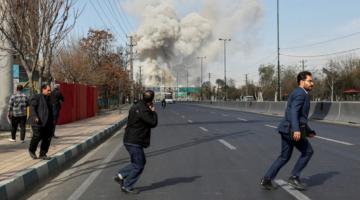 The demand to call out alleged crimes in Iran or Cuba while those countries face annihilation from the U.S. and Israel is a refusal to see those people as human beings worthy of protection.
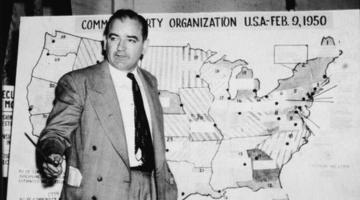 Red Scares are a recurring feature of the U.S. political tradition aimed at criminalizing anticapitalist politics through accusations of foreign infiltration and conspiracy. The NSPM-7 and the report…
 For several years, three landlocked West African states have undergone political transformations designed to turn the page on French neo-colonialism.
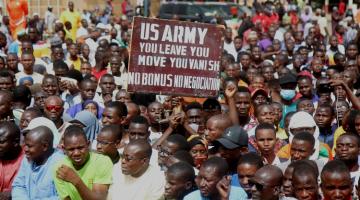 The U.S. is considering drone strikes and sanctions against the Alliance of Sahel States under the guise of counterterrorism, but the real objective is to regain neo-colonial control over African…
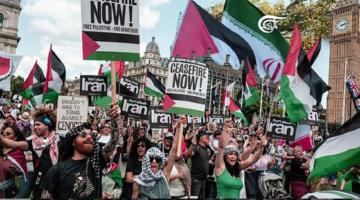 Western pro-Palestinian activism isolates Palestine from its regional allies, depoliticizing its struggle and reinforcing colonial divisions.


