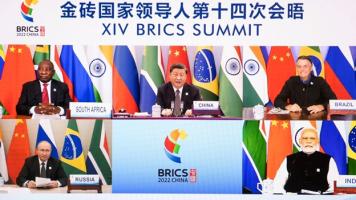
Brazil's President Luiz Inacio Lula da Silva, China's President Xi Jinping, South Africa's President Cyril Ramaphosa, India's Prime Minister Narendra Modi and Russia's Foreign Minister Sergei Lavrov (Photo: Government of South Africa)
The expansion of the BRICS beyond Brazil, Russia, India, China and South Africa is an important development but not one that will challenge U.S. efforts at domination.
Originally published in Morning Star Online.
As significant as the fact of BRICS expansion are which countries are now set to join: Iran, Saudi Arabia, Egypt, the United Arab Emirates, Ethiopia and Argentina.
The six applicants will mean the BRICS (which already account for a larger share of world GDP than the G7 group of developed capitalist countries) rise to representing 37 per cent of the global economy and 46 per cent of the human race.
They are also heavily concentrated in the Middle East, a region traditionally dominated by US imperialism. There is a definite move from Middle Eastern powers away from Washington’s orbit and the implications for continued US hegemony could be great.
Could be. Socialists should be alert both to the positive aspects of BRICS expansion and to the many contradictions within the group, some already being exploited by Western imperialist powers.
BRICS expansion indicates the rise of the global South. BRICS countries share an — entirely accurate — perception that most global institutions, especially financial institutions such as the IMF and World Bank, are instruments used by the United States and the old imperialist powers to maintain economic dominance through control of other countries’ resources.
Changing economic interests provide opportunities to resolve longstanding feuds. China’s brokering of a rapprochement between Iran and Saudi Arabia may — we do not know — have been facilitated by promised BRICS membership for both.
Its immediate consequence was progress towards a peace in Yemen between the Saudi-led coalition and the Iran-backed Houthi movement. An end to Saudi-Iranian rivalry weakens the US in the Middle East and it is no surprise that Western powers have not welcomed a prospective end to the Yemen war.
Britain — so dedicated to Saudi victory it maintained arms sales even when the US paused them over the murder of Jamal Khashoggi, and which has provided extensive logistical support for an air force bombing hospitals, schools and residential areas — is reportedly deploying extra troops to oil-rich eastern Yemen, while Mohammad al-Atifi, defence minister in the Houthis’ Government of National Salvation, said this month that the US and Britain were “leaving no stone unturned to obstruct” any peace deal.
Iran and Saudi Arabia joining the BRICS makes the success of these spoiler schemes less likely. But not impossible. Existing BRICS members are regularly at loggerheads. India — a core member in the seemingly anti-US-hegemony BRICS — is simultaneously a member of the Quad, a US-led anti-China military bloc.
BRICS expansion shows the decline of US power. Its efforts to isolate Russia following the invasion of Ukraine have only worked on its closest allies: most of the world isn’t listening.
But it does not indicate any coherent foreign policy on the part of the BRICS themselves, unlike the ideologically aligned G7. And the US’s military and economic dominance over its European and East Asian allies has if anything increased since the Ukraine war started, with Nato expanding and Japan both rearming and in US-brokered engagement with South Korea.
The BRICS’ ideological diversity is a strength and a weakness.
It allows any country looking to challenge a “rules-based international order” in which the US makes and breaks the rules to see advantages in membership. This shared interest can unite old enemies and bring together progressive governments with some of the world’s most reactionary ones.
But it does not systematically oppose imperialism, as India’s military alliance with the US in the Indo-Pacific (or that of Brazil in Latin America under former president Jair Bolsonaro) shows, and as we see in Yemen, imperialism will “leave no stone unturned” to divide and rule.
The rise of the BRICS is not enough to displace the US or avert a third world war. Anti-imperialists in remaining US allies like Britain must do what we can to halt the drive towards militarisation and end our governments’ subordination to Washington.
Morning Star Online is the only English-language socialist daily newspaper in the world, published six days a week.



 Brilliant and amazingly multitalented, Robeson was once among the most popular men in the U.S;, but became a non-person under relentless red-baiting.
 Ruchell Magee is the longest-held political prisoner in the United States and the world.
 Even as many more people around the world have access to education, schooling everywhere remains intertwined with systems of oppression, including racism and capitalism.
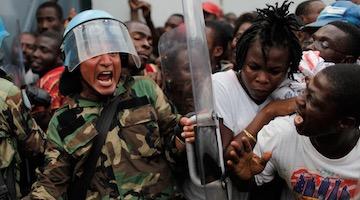 For fifteen years Latin American nations collaborated in the military occupation of Haiti, but have yet to apologize for their crimes.
 Insiders say Dataminr’s “algorithmic” Twitter search involves human staffers perpetuating confirmation biases, searching specific neighborhoods, streets, and even housing complexes for crime.



