Former Black Panther Deputy Minister of Defense Byron Booth's journey from Compton to Cuba, Algiers to Lagos, reveals the global reach of Black radicalism in a 2016 interview.
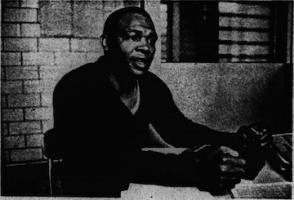
I interviewed Byron Booth in my living room one autumn afternoon. Wiry and sharp-eyed at seventy-two, he leaned toward the microphone and began, "My name is Byron Booth. I was born in Chicago,1944, September first, in Cook County Hospital."
Booth's family history spanned the brutal arc of American contradictions. His father descended from enslaved people on the Booth plantation in Georgia; his mother's family were Choctaw Indians, survivors of the forced march from Mississippi to Oklahoma. His grandfather Perry Catron became one of the first Native Americans on the Chicago police force. Growing up mixed-race on the South Side, Booth heard slurs like "half-breed,” while observing the caution his parents carried in white neighborhoods. "I noticed it when I was about four years old," he said. His most searing childhood memory was the lynching of Emmett Till in 1955. "Everybody was upset," Booth recalled. "People cried on the streets in public." That day confirmed for him the war he already felt he had been born into.
By the late fifties, Booth's family had moved to Los Angeles, settling in Compton just as blockbusting transformed it from a white suburb into a Black community. At Walton Junior High, Booth staged a fight that neighbors mistook for a killing. To avoid jail, his family sent him back to Chicago. Within a year he returned and enrolled at Compton High. There were fights with white students, but also unexpected friendships. Japanese classmates introduced him to judo and kendo. He discovered a love for science and chess, sharpening a strategic mind that would guide him later in life.
But resistance defined him. His refusal to bow to authority led to stints in the California Youth Authority and eventually Soledad Prison after a robbery conviction. There, he encountered men who would shape the Black Power era: Eldridge Cleaver, Bunchy Carter, and George Jackson. Together they launched an Afro-American studies class, reading and debating politics. "We talked about creating an organization that would fight and stop these people," Booth told me. They were preparing for a revolution, not yet knowing that Huey Newton and Bobby Seale were already building the Black Panther Party on the outside.
Cleaver was paroled in 1966 and soon became the Panthers' Minister of Information. Booth, transferred to Chino to disrupt the radical core at Soledad, remained behind bars. From outside, Cleaver began plotting his escape. In 1969 Booth and Clinton "Buster" Smith slipped past patrols, scaled fences, and boarded a National Airlines flight. Airline security then was minimal-no metal detectors, no ID checks. Midair, Booth pressed a revolver into a stewardess's back and declared, "I'm your new captain. We're going to have a holiday in Cuba."
In Havana, the romance of revolution faded quickly. Smith cut cane in the fields; Booth washed test tubes in a lab. They were watched by Cuban intelligence and kept at arm's length. Eventually Cleaver arranged for them to leave. In 1970, their flight stopped in Algiers, where North Korean officials warned them not to continue to Syria. Booth stepped onto African soil at last. "Finally," he thought. "That's part of the destination."
For a time, Algiers was the capital of the Third World. Liberation movements kept offices there, and the Panthers declared it their International Section. Booth became Deputy Minister of Defense, traveling with Cleaver to Pyongyang and even to Hanoi. For the first time, he said, he felt free of the burden of being a Black man in America. He was treated as an equal, a comrade, a delegate. Yet exile also brought betrayal. Cleaver's paranoia turned inward, and one night he killed Clinton Smith – the very comrade who had escaped Chino with Booth. Shaken and disgusted, Booth fled to Egypt, then to Nigeria.
Lagos offered Booth opportunity and belonging. He became a police intelligence officer, owned businesses, and moved in the orbit of ministers and musicians. Afrobeat legend Fela Kuti called him "brother." Booth remembered late nights in Fela's Shrine, the nightclub pulsing with horns and drums, where smoke thickened the air and militants rubbed shoulders with diplomats. Nigeria gave him what America never had: belonging. "Doors opened," he said.
But the United States never forgot. Booth remained on the radar of U.S. intelligence. In 2001, after more than three decades abroad, Nigerian authorities closed in. Booth hurled himself into a lagoon in one last attempt to escape but was dragged out, shackled, and flown back to the United States.
In court, he pled guilty to interference with a flight crew. The charge reduced the radicalism of his odyssey to a technical violation, as though hijacking were not a political act but a disruption of in-flight etiquette. He was sentenced to twelve years in federal prison. From his cell, he tracked down Buster Smith's family, writing a twelve-page letter to tell them the truth: Buster had been killed in Algiers. It was a belated act of witness.
Released in 2013, Booth returned to Los Angeles, often unhoused, sometimes hustling for change at gas stations. Yet his story-Chicago, Compton, Cuba, Algiers, Lagos-remained intact. For me, interviewing Booth was not about resurrecting myth but restoring truth. His life was improbable, but it was real, corroborated by William Cordova's Odyssey of Byron Booth.
When I think of Booth, I don't see only the hijacker or the fugitive. I see a man who lived the twentieth century at its edges, who carried his battles from Chicago streets to Algiers embassies, and who reminded me that oral history is not merely memory. It is evidence that the fight for freedom was never local, never isolated, but part of a global war against empire itself. Booth's life was, as he put it, a geography of freedom.
Editor’s Note: Byron Booth lives in California. He was the subject of the 2025 book, The Odyssey of Byron Booth.
Dr. Karin Stanford is Special Projects Director of the Black Power Archives at California State University Northridge. The 2016 interview with Byron Booth was conducted by Dr. Stanford and Dr. Keith Rice.



 The Islamic Revolutionary Guard Corps (IRGC) has issued a letter addressed to the American people, outlining its views on recent developments and Iran-U.S. relations.
 The Trump administration's new sanctions on Cuba, are part of a dual strategy to create unendurable hardship while simultaneously making Cuba financially dependent on the United States.
 The armed groups in Haiti are not a spontaneous wave of banditry, but a scheme orchestrated by imperialist powers in concert with a reactionary and subservient Haitian political class. The…
 A coalition of Pan-African and socialist organizations has launched an international campaign to defend Cuba, arguing that African peoples must remember the sacrifices Cuban internationalists made…
 If international law and justice are buried in the rubble of Gaza, the global community will ultimately be digging its own grave.


