by AlterPresse
Since 1915, the United States has directly or indirectly occupied Haiti, smothering the nation’s sovereignty and corrupting its institutions. This year, a People’s Court will begin hearing testimony from Haitians on the crimes of the U.S. occupiers. The tribunal is a response “to the generalized demand to fight for justice and against the constant impunity that harms the entire population.”
Haitian People’s Court Will Put 100 Years of U.S. Occupation on Trial
by AlterPresse
This article previously appeared in AlterPresse and The Dawn News.
“The sentence of the symbolic People’s Court will be pronounced on July 28, 2018.”
July 28, 2017, is the deadline to deliver denounces to the symbolic People’s Court, which has been called to examine the 100 years of US occupation of Haiti (from 1915 to 2015). This initiative has been created thanks to a joint effort by many social organizations.
From January to February 2017, the organizers will visit all of Haiti’s departments to create departmental committees, as reported by the representative of the Committee of Direction and Coordination of the People’s Court, Camille Chalmers, in a conference/debate on January 17, which was attended by online agency AlterPresse.
Between February and May 2017, accusations will be made based on testimonies, scientific research and documentation provided by all the regions and sectors, Chalmers announced.
The trial against the century of US occupation will begin the moment the accusations are received by the court. Then, a calendar for formal audiences will be set.
One hundred audiences are expected to be held throughout the territory to deepen the task of political education of the people. The Court will be seated permanently after officially receiving the proceedings.
“The traditional Justice system of Haiti is closed to them and doesn’t defend their interests.”
Instead of having the Court be an isolated event, the organizations behind it have decided to generate a long process that began with a petition signed by 350 organizations, followed by an Assembly held July 12, 2016, which helped create the Committee of Direction and Coordination of the People’s Court.
The sentence of the symbolic People’s Court will be pronounced on July 28, 2018.
Chalmers said he desires to create a Permanent People’s Court to examine other issues and trial other subjects.
Sessions of the People’s court are expected to be held in several cities, especially in the ones that had an important role in the resistance and the struggle against occupation such as Cap-Haïtien (Nord department), Hinche (Centre department), Marchand-Dessalines (Artibonite department) and Les Cayes (Sud department).
Chalmers emphasized the need to fight against the “crime of silence” and respond to the generalized demand to fight for justice and against the constant impunity that harms the entire population.
“Many areas of society truly don’t have access to the traditional Justice system of Haiti, which is closed to them and doesn’t defend their interests”, Chalmers pointed out.
Therefore, he said, “we have to build a space that is symbolically inspired by the Court, and has to function as a way to criticize the role of the judicial system,” and added that “we must prove that this demand of justice can’t be satisfied through traditional channels.”

 In this week’s segment, we discuss the Supreme Court ruling that ends Temporary Protected Status (TPS) for Haitian immigrants. But we begin with South Africa and discuss the origins of xenophobic…
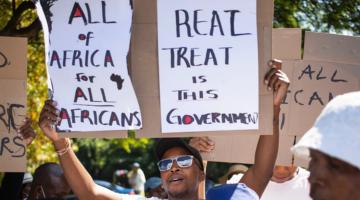 What is behind this South African movement that drives immigrants out of the country? We are joined by Nairobi-based political writer and strategist Clinton Nzala, who provides analysis on the…
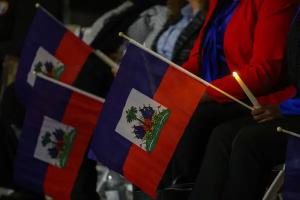 On June 25, the Supreme Court of the United States ruled that Temporary Protected Status (TPS) for Haitians and Syrians would end. What does this ruling mean for the more than 350,000 Haitians living…
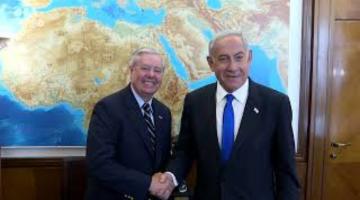 The late Senator Lindsey Graham played the role of chief congressional warmonger very well. But many of his colleagues, who spoke in quieter voices, were completely aligned with his support of U.S.…
 The U.S.-EU-NATO axis remains intact, and its commitment to militarism represents an existential threat to the world.


