The Forgotten Socialist History of Martin Luther King Jr.
MLK was dreaming of a socialist future long before the tumultuous decade of the Sixties.
“Capitalism has created conditions permitting necessities to be taken from the many to give luxuries to the few.”
In 1952 a 23-year-old Martin Luther King Jr. wrote a love letter to Coretta Scott. Along with coos of affection and apologies for his hasty handwriting, he described his feelings not just toward his future wife, but also toward America’s economic system. “I am much more socialistic in my economic theory than capitalistic,” he admitted to his then-girlfriend, concluding that “capitalism has outlived its usefulness.”
King composed these words as a grad student on the tail end of his first year at the Boston University School of Theology. And far from representing just the utopianism of youth, the views expressed in the letter would go on to inform King’s economic vision throughout his life.
As Americans honor King on his birthday, it is important to remember that the civil rights icon was also a democratic socialist, committed to building a broad movement to overcome the failings of capitalism and achieve both racial and economic equality for all people.
“The civil rights icon was also a democratic socialist.”
Capitalism “has brought about a system that takes necessities from the masses to give luxuries to the classes,” King wrote in his 1952 letter to Scott. He would echo the sentiment 15 years later in his last book, Where Do We Go From Here: Chaos or Community?: “Capitalism has often left a gap of superfluous wealth and abject poverty [and] has created conditions permitting necessities to be taken from the many to give luxuries to the few.”
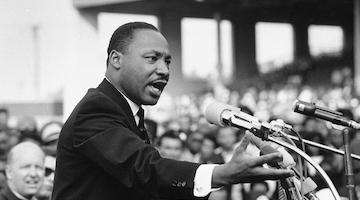
In his famous 1967 Riverside Church speech, King thundered, “When machines and computers, profit motives and property rights are considered more important than people, the giant triplets of racism, materialism and militarism are incapable of being conquered.”
And in an interview with the New York Times in 1968, King described his work with the Southern Christian Leadership Conference (SCLC) this way, “In a sense, you could say we are engaged in the class struggle.”
“Capitalism has often left a gap of superfluous wealth and abject poverty.”
Speaking at a staff retreat of the SCLC in 1966, King said that “something is wrong … with capitalism” and “there must be a better distribution of wealth” in the country. “Maybe,” he suggested, “America must move toward a democratic socialism.”
In Where Do We Go From Here, which calls for “the full emancipation and equality of Negroes and the poor,” King advocates policies in line with a democratic socialist program: a guaranteed annual income, constitutional amendments to secure social and economic equality, and greatly expanded public housing. He endorses the Freedom Budget put forward by socialist activist A. Philip Randolph, which included such policies as a jobs guarantee, a living wage and universal healthcare. He also outlines how economic inequality can circumscribe civil rights. While the wealthy enjoy easy access to lawyers and the courts, “the poor, however, are helpless,” he writes.
“’Maybe,’ King suggested, ‘America must move toward a democratic socialism.’”
This emphasis on poverty is not always reflected in contemporary teachings about King, which tend to focus strictly on his advocacy for civil rights. But Where Do We Go From Here and the final project of King’s life—the Poor People’s Campaign—show that King’s dream included a future of both racial and economic equality.
“What good is having the right to sit at a lunch counter,” King is widely quoted as asking, “if you can’t afford to buy a hamburger?” In King’s view, the Greensboro lunch counter sit-ins, the voter registration drives across the South and the Selma to Montgomery march comprised but the first phase of the civil rights movement. In Where Do We Go From Here, King called the victories of the movement up that point in 1967 “a foothold, no more” in the struggle for freedom. Only a campaign to realize economic as well as racial justice could win true equality for African-Americans. In naming his goal, King was unflinching: the “total, direct, and immediate abolition of poverty.”
“King endorsed the Freedom Budget, which included such policies as a jobs guarantee, a living wage and universal healthcare.”
The shortcoming of the first phase of the civil rights movement, to King, was its emphasis on opportunity rather than guarantees. The ability to buy a hamburger at a lunch counter without harassment did not guarantee that the hungry would be fed. Access to the ballot box did not guarantee anti-racist legislation. The end of Jim Crow laws did not guarantee the flourishing of African-American communities. Decency did not guarantee equality.
Some white people had gone along with the fight for access and opportunity, King concluded, because it cost them nothing. “Jobs,” however, “are harder and costlier to create than voting rolls.” When African-Americans sought not only to be treated with dignity, but guaranteed fair housing and education, many whites abandoned the movement. In King’s words, as soon as he demanded “the realization of equality”—the second phase of the civil rights movement—he discovered whites suddenly indifferent.
King considered the Poor People's Campaign to be the vehicle for this next phase of the movement precisely because it offered both material advances and the potential for stronger cross-racial organizing. For King, only a multiracial working-class movement, which the Poor People's Campaign aspired to be, could guarantee both racial and economic equality.
“When African-Americans sought not only to be treated with dignity, but guaranteed fair housing and education, many whites abandoned the movement.”
King was disgusted by the juxtaposition of decadence and destitution in America. We “compress our abundance into the overfed mouths of the middle and upper classes until they gag with superfluity,” he fumed. Quoting social justice advocate Hyman Bookbinder, King wrote that ending poverty in America merely requires demanding that the rich “become even richer at a slower rate.”
For King, the only solution to America’s crisis of poverty was the redistribution of wealth. In a 1961 speech to the Negro American Labor Council, King declared, “Call it democracy, or call it democratic socialism, but there must be a better distribution of wealth within this country for all God’s children.”
From his early letters to Coretta Scott until his final days, King put forward a vision of a society that provides equality for people of all races and backgrounds. This is the cause King spent his life fighting for. And it is one we should recommit to as we honor his legacy.
Matthew Miles Goodrich is a writer and organizer in Brooklyn. He serves as digital editor for Guernica and trains with the populist climate movement Sunrise.
This article previously appeared in In These Times and Portside.



 "What’s with a Pomade Man’s testosterone obsession?" is the latest from BAR's Poet-in-Residence
 Johanna Fernandez left a powerful and revolutionary legacy through her scholarship and activism.
 Johanna Fernandez touched many lives through her scholarship, activism, and belief that people themselves can change history and be "the ones we've been waiting for."
 "Unlike the Zionist claim that 'Israel has a right to exist,' my assertion is rooted in international law. Of course, given Israel’s propensity for violating such laws, it’s no surprise they’re still…
 The recent report by the U.S. fascist state attacking Cuba and its allies serves as a glaring call for urgent and strategic unity among the broadest sectors of the U.S. left, and all people of…


