A Black Agenda Radio commentary by Glen Ford
In any global battle of the racists, the U.S. and Britain are always top contenders. A new study has some putting odds on merrily racist Old England (and Wales) for the honor of white supremacist society in-chief. “The figures would seem to indicate that Blacks in England and Wales are targeted by police with even more ferocity than their counterparts in New York City.” But the Big Apple takes a back seat to no one, when it comes to bigoted police behavior on the streets.
Whose Cops are More Racist, America’s or the Brits'?
A Black Agenda Radio commentary by Glen Ford
“Blacks in England and Wales are 26 times more likely to be stopped and frisked on the streets than whites.”
The United States criminal justice system has been called the most racist on the planet. And, by most measures, that’s true. But Blacks in Great Britain are also under siege by police – enough to generate a recent visit to London by Rev. Jesse Jackson. A new study shows that Blacks in England and Wales are 26 times more likely to be stopped and frisked on the streets than whites, a figure that Rev. Jackson said “undermines the moral authority” of the United Kingdom. It would be hard to criticize the analysis for sloppiness; it was conducted by the London School of Economics, in collaboration with the Open Society Justice Initiative.
On the face of it, the figures would seem to indicate that Blacks in England and Wales are targeted by police with even more ferocity than their counterparts in New York City, where a similar stop-and-frisk campaign has scooped up progressively larger numbers of Blacks and Latinos in recent years. In England, Section 60 of the 1994 Criminal Justice and Public Order Act was originally promulgated to deal with rowdy soccer hooligans, most of whom are white, but has in recent years turned into a mechanism to disproportionately stop Blacks on the streets.
New York City’s stop-and-frisk regime has drastically escalated under billionaire Mayor Michael Bloomberg, who has also dramatically ramped up the pace of gentrification. Strong pressures also exist in England to contain the non-white population.
“U.S. cops stop a much higher percentage of the people – about 25 times as many per capita.”
But, are the police in England and Wales really more viciously racist than New York City cops? With Black Brits 26 times more likely to be stopped than whites, while Black New Yorkers are only 9 times more likely, one might conclude that the English cops behave in a more racist manner. But the sheer numbers of stop-and-frisks in New York City may say otherwise. In 2009, only about 150,000 people were stopped on the streets in all of England and Wales, home to 54 million people. New York City has 8 million residents, less than one-sixth the size of England and Wales, but its cops stopped nearly 600,000 people, four times as many, the vast majority of them Black and Latino.
The conclusion: When English cops stop someone on the street, it is more likely to be a Black person than a white – more likely than when New York cops make a stop: 26 to 1 versus 9 to 1. But U.S. cops stop a much higher percentage of the people – about 25 times as many per capita. What that would tend to indicate is, that a Black Brit might think he had it bad in England, but he'd be more likely to get picked out to be stopped and searched on the streets of New York, because of the sheer volume of stops in the Big Apple.
The same applies to prison. The Black-white incarceration ratio is worse in Britain than it is in the United States. But the U.S. imprisons four times as many people per capita as the Brits do and holds a full 3 percent of the Black U.S. population behind bars. For Blacks in Britain, it's only 1 percent. So yes, it's true: the U.S. does have the most racist criminal justice system in the world. For Black Agenda Radio, I'm Glen Ford. On the web, go to www.BlackAgendaReport.com.
BAR executive editor Glen Ford can be contacted at Glen.Ford@BlackAgendaReport.com.

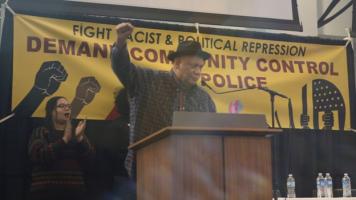 Frank Chapman is Executive Director of the National Alliance Against Racist and Political Repression. That organization led the fight for community control of the police, with the creation of the…
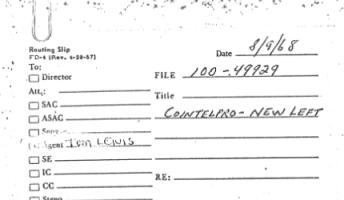 On March 8,1971 a brave group of people revealed the extent of FBI spying, harassment and even the killings of US citizens. More than 50 years later we would do well to remember the significance of…
 Revisiting a 1974 editorial on Black women and the international struggle against patriarchy, racism, imperialism, and capitalism on International Women’s Day.
 In Africa as in the rest of the world, US machinations undermine its goals and bring other nations together as they seek to protect themselves from a desperate empire.
 …
…


