A Black Agenda Radio commentary by Glen Ford
In just four years, the United States will fall behind China as the world’s largest economic engine. The problem is, what the U.S. cannot achieve by economic or diplomatic means, it will attempt to accomplish by military force. America will not graciously accept decline. “It is a crisis, not of an ordinary nation state that happens to be an economic giant, but of a global system: imperialism.”
What Will the U.S. Do When It’s Number Two?
A Black Agenda Radio commentary by Glen Ford
“The pace of Washington’s aggressions in the world seems to be mounting as it approaches inevitable eclipse by Beijing in economic output.”
How will the United States react when China becomes the number one economy in the world? It’s a very serious question, because the U.S. is a very dangerous country, that still operates on the assumption that it has a Manifest Destiny to dominate the world. When the reigning superpower confronts its economic second fiddle status in 2016, it could throw quite a troublesome tantrum. In fact, the pace of Washington’s aggressions in the world seems to be mounting as it approaches inevitable eclipse by Beijing in economic output, as measured by the purchasing power parity
Business Week magazine pondered America’s decline relative to China back in October of last year, noting that China’s economy had been the world’s largest for hundreds of years, until it was overtaken by the U.S. in 1890
Economist Dean Baker took a look at the U.S. as number two, last week 20 percent larger
“It is a question of the survival of their rotten system.”
Having been forced, by capitalism’s inherent contradictions, to export production of actual goods to the South and the East – much of it to China – the Americans and western Europeans have lost their ability to dominate the terms of global trade – at least, by economic means. Their own multinational corporations have expedited the deindustrialization of the home countries. The increased “options” that Baker refers to as being available to the former Third World – to Africa, Latin America and Asia – represent mortal dangers to the U.S. and its imperial junior partners. The Americans and Europeans cannot compete with China, India, Brazil and other rising economic players, and cannot sustain their inherently unstable, casino-like financial structures in the absence of ever-increasing profits. Colonialism and neocolonialism provided such profits, while locking the rest of the world in a straightjacket – like China used to be.
The imperialists have always rigged world markets to their own super-advantage. Otherwise, they cannot compete. So, it is not just a question of whether U.S. rulers will accept being number two. Rather, it is a question of the survival of their rotten system. That's why they spend more on weapons than the rest of the world, combined. And that's why a United States in decline is a grave danger to the entire planet. It's going to be a very rough ride down.
For Black Agenda Radio, I'm Glen Ford. On the web, go to BlackAgendaReport.com.
BAR executive editor Glen Ford can be contacted at Glen.Ford@BlackAgendaReport.com .

 In this week’s segment, we discuss why Israel is the first and only nation to recognize the Somaliland region of Somalia and the impact of this act on the Horn of Africa region. But we begin with a…
 The U.S. attack on Venezuela and kidnapping of the president and first lady are the culmination of years of intervention against that state. Corinna Mullin discusses the importance of anti-…
 Israel is the first and only nation to recognize the Somaliland region of Somalia as an independent state. The zionist entity's plan to establish a military presence will enhance the U.S. decades-…
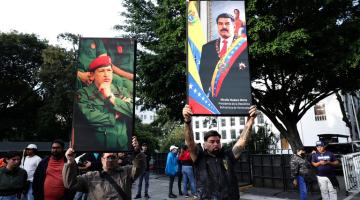 Director of the North-South Project for People(s)-Centered Human Rights, Ajamu Baraka, joins Spotlight on Press TV to analyze the latest developments in Venezuela, how and why this illegal…
 Black Agenda Report Special Issue on Venezuela.


