by PANW correspondent
The world’s chief imperialist may be an African American, but so were many of the most committed anti-war activists gathered at UNAC’s national conference. “It is important for the anti-interventionist movement in the U.S. to totally integrate the support for the masses of African people in their resistance to the Pentagon, the CIA, Africom, NATO and Israeli involvement in Africa.”
UNAC Conference: African Americans in the Struggle Against War and Imperialism
This article originally appeared on the Pan African News Wire.
by PANW correspondent
“African people have been at war with imperialism at least since the 15th century.”
STAMFORD, CT—Hundreds of activists representing dozens of organizations attended the second national conference of the United National Anti-War Coalition (UNAC) that was held in Stamford CT over the weekend of March 23-25. The event, convened under the theme “Say No to the NATO/G8 Wars & Poverty Agenda,” featured plenary sessions and workshops that approached the rising imperialist threat of militarism, repression and austerity from a myriad of perspectives.
Organizations and scholars discussed the plight of the majority of people throughout the world who are negatively impacted by the burgeoning Pentagon budget and the ongoing world economic crisis. The event was sub-titled “A Conference to Challenge the War of the 1% Against the 99% at Home and Abroad.”
On the second day of the conference, two workshop panels were held that highlighted the role of militarism and state repression in oppressing, exploiting and destabilizing the peoples of Africa and African descendants inside the United States and across the Black Diaspora. The panels brought together some of the leading forces in the U.S. who have decades of experience in the movements for self-determination, African liberation, workers’ rights and anti-imperialism.
The first panel held during the morning sessions on March 24 was entitled “Antiwar Strategies in Black Community Organizations.” This panel was chaired by Ana Edwards of Richmond, Virginia who is affiliated with the Sacred Ground Reclamation Project, the Virginia Defenders for Freedom, Justice & Equality, the Virginia Peoples Assembly and is a member of the UNAC national steering committee.
“African Americans today are in a serious struggle for economic and social survival.”
Other panelists who addressed the standing-room-only audience were Abayomi Azikiwe, editor of the Pan-African News Wire and co-founder of the Michigan Emergency Committee Against War & Injustice (MECAWI) from Detroit, Brenda Stokely, Co-Chair of the Million Worker March and a longtime labor organizer and official with AFSCME in New York City, Ajamu Baraka of the Black Left Unity Network (BLUN) from Charlottesville, Virginia and Clarence Thomas, organizer of the Million Worker March and a leading member of the International Longshoreman & Warehouse Union (ILWU) in Oakland, California.
Azikiwe, who was the first speaker on the panel after introductory remarks from Ana Edwards, stated that “When we examine the question of anti-war organizing in the Black community it must be done from an historical perspective. African people have been at war with imperialism at least since the 15th century.”
In discussing the rich ten-year history of MECAWI in Detroit and the state of Michigan, the PANW editor noted that “MECAWI believes firmly in linking the struggles against imperialist wars in Africa, Asia, Latin America and the Middle East to the struggle inside the U.S. against national oppression, economic exploitation, political repression, gender oppression and all forms of injustice.” Azikiwe gave examples of MECAWI’s work in reclaiming the legacy of MLK’s anti-war and social justice tradition through organizing large rallies and marches every year on the federally-recognized holiday in honor of the civil rights martyr’s birthday.
“The antiwar movement leadership must approach the Black community based upon the concrete needs of the people.”
Brenda Stokely pointed out that African Americans today are in a serious struggle for economic and social survival. She said that “my own nephew has been grappling with whether to join the military because the prospects for employment and education have been taken away by the system in the United States.”
“We must explain in simple terms, and not using rhetoric, the realities of U.S. military involvement around the world. The antiwar movement leadership must approach the Black community based upon the concrete needs of the people,” Stokely said.
Ajamau Baraka explained the class character of the African American struggle and how the Black working class has no interests in supporting imperialist wars. Baraka also emphasized the plight of Africans in Latin America and how they are a strong presence on the continent of South America and should be sought out as allies in the global struggle against imperialism.
ILWU organizer and militant activist Clarence Thomas reflected on the recent developments in the Bay Area and along the west coast. He explained the important victory of the ILWU over EGT which had taken action aimed at breaking the union, one of the most progressive and internationalist inside the U.S.
Panel on Africom and NATO
Later that same day in the afternoon another capacity audience panel was held under the title of “Defeating Africom and NATO; Building Solidarity With Africa in the Struggle Against Imperialism.” This panel was moderated by Abayomi Azikiwe who has written extensively on U.S. and NATO militarism in Africa.
Other panelists in this workshop were Ana Edwards, who has travelled and established people-to-people relations with the nation of Mali, and Sobukwe Shukura, an organizer for the All-African People’s Revolutionary Party (A-APRP) and the National Network on Cuba. The panel lasted for two hours and was characterized by profound presentations and penetrating questions and comments from the audience.
Azikiwe, the moderator, began the discussion by pointing out that “The overwhelming sentiment both within and outside governments, was in opposition to Africom being based on the continent. Since 2008, the Pentagon has used different tactics designed to promote and sell Africom to Africa.”
In concluding his remarks, Azikiwe stressed that “It is important for the anti-interventionist movement in the U.S. to totally integrate the support for the masses of African people in their resistance to the Pentagon, the CIA, Africom, NATO and Israeli involvement in Africa. We are part and parcel of the global struggle against imperialism and all of its manifestations.”
“Pentagon has used different tactics designed to promote and sell Africom to Africa.”
Ana Edwards discussed in detail the post-colonial history of the West African state of Mali which has recently experienced a Tuareg rebellion in the north and a military coup in Bamako the capital. Edwards emphasized the role of Africom in Mali and the need to build solidarity with the people of this gold-producing nation that is suffering from outside intervention and underdevelopment.
Sobukwe Shukura began his presentation with a recorded excerpt from an address by Dr. Kwame Nkrumah, the first president of Ghana and leader of the African Revolution of the 1950s and 1960s, saying that “the enemy is imperialism.” Shukura reviewed the necessity of African unity in the struggle against foreign intervention pointing to Libya and other regions of the continent.
Shukura emphasized the role of Cuba in assisting African revolutionary movements in Angola during the 1970s and 1980s which led to the total independence of the Southern African region of the continent. Cuba remains a staunch ally of the African people through medical and technical assistance afforded to millions across the region.
The UNAC conference was attended by several left organizations that are based in the African American community. These groups included Black Agenda Report, the A-APRP, Black Left Unity Network, Harlem Tenants Council, the Lynn Stewart Defense Committee, the Virginia Defenders, MECAWI, Occupy Harlem, the Stamford, CT NAACP chapter, among others.
Distributed By: The Pan-African Research and Documentation Project. email: panafnewswire@gmail.com

 A pamphlet written 70 years ago by an exiled Black American communist reveals an African continent seething to break free from European colonization.
 The real story of the Rwandan genocide begins in 1990, when exiled Tutsis from Uganda invaded northern Rwanda, unleashing a deadly campaign that uprooted a million Hutu peasants and set ethnic tens
 Northeast, midwest, southwest, south, down south, up south, out south—south of the Canadian border—Slouched down in his cruiser, slow-rollin’ the ‘hood; Or a-
 The new Democratic administration seems determined to sabotage an agreement to end the “longest war.”
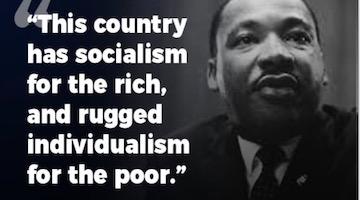 King explicitly linked the value of human dignity to the material conditions necessary to enable people to live a decent life.


