by BAR editor and columnist Jemima Pierre
With a Black man in the White House, the African American political class has all but abandoned solidarity with Haiti. “U.S. Blacks’ hard-earned moral authority continues to deteriorate as they continue to condone—by silence and inaction—the current violation of Haitian rights and sovereignty by the U.S. government.” By walking in lockstep with Barack Obama, African Americans are using up generations of international political capital and making themselves increasingly irrelevant to world developments. “Where once Black folk actively challenged U.S. imperialism, today some are more than happy to have a Black commander at the helm.”
Our Failure on Haiti
by BAR editor and columnist Jemima Pierre
“Except for a notable few, most U.S. Black intellectuals have remained silent as the indignities pile on the Haitian nation under this Black president.”
Since Barack Obama became U.S. president his government has sponsored fraudulent elections in Haiti, has forced the installment of Duvalierist neo-colonial puppet Michel “Sweet Micky” Martelly, has allowed the dictator and human rights abuser Jean Claude “Baby Doc” Duvalier to return to Haiti unscathed, has supported Bill Clinton’s control over Haitian politics, and has used the United Nations military occupation (MINUSTAH) of the country as the core of its regional foreign policy.
Where is the outrage from the U.S. Black left? Where are the progressive U.S. Black intellectuals? Except for a notable few, most have remained silent as the indignities pile on the Haitian nation under this Black president. They will not critique the U.S. imperial project—from illegal wars and occupation to increased Black economic suffering. No. The Black president must be protected at all costs, even as his administration violates the independence of the world’s first Black republic.
U.S. Blacks’ hard-earned moral authority continues to deteriorate as they continue to condone—by silence and inaction—the current violation of Haitian rights and sovereignty by the U.S. government. At the very least, we are witnessing the complete failure of Pan-African politics of solidarity in this age of “post-Blackness.”
“The Black president must be protected at all costs, even as his administration violates the independence of the world’s first Black republic.”
It wasn’t always this way.
During the first U.S. military occupation of Haiti from 1915 to 1934, Blacks boldly struggled against the usurpation of Haitian sovereignty. Outraged by the racist brutalities of the occupation, W. E. B. Du Bois used The Crisis as a platform to rally U.S. Blacks against their government’s actions in Haiti. To him, the fight was the same: “The lynching and murder in Port-au-Prince is no worse than, if as bad as, the lynching in Georgia.” In March 1920, the NAACP sent its Field Secretary, James Weldon Johnson, to investigate the “unlawful seizure of that country by the American government and the exploitation and abuse of its people under American military occupation.” Johnson returned and published numerous articles in The Nation, The Crisis, and The Christian Herald charging the U.S. government of brutal crimes in Haiti. The U.S. crimes in Haiti extended beyond the forced labor brigades and lynchings; they also included the U.S. business community’s—especially the National City Bank of New York—in taking over the Haitian economy through its U.S. government-sanctioned takeover of Haiti’s national bank. Johnson’s publicity work influenced the campaign of then-presidential candidate Warren Harding to attack U.S. policy in Haiti. From Johnson’s work, the NAACP was also able to bring attention to the brutal murder of more than 3000 Haitians at the hand of U.S. soldiers.
One of the most important results of Johnson’s trip to Haiti was the formation of the Union Patriotique d’Haiti (the Patriotic Union of Haiti). A result of conversations between radical African Americans and Haitian activists and diplomats this group’s objective was to work “in accord with the defenders of Haitian cause in the United States” and to respond to the propaganda used to justify U.S. government interference in Haitian affairs. Here was a transnational, pan-African collaboration of U.S. Blacks and Haitians directly challenging U.S. foreign policy.
“James Weldon Johnson returned and published numerous articles in The Nation, The Crisis, and The Christian Herald charging the U.S. government of brutal crimes in Haiti.”
Of course, not all U.S. Black individuals and organizations were as radical then. Booker T. Washington, for example, saw the U.S. occupation of Haiti as a necessary evil, a way to “help the Haitians govern their own country.” But even he lamented the racist actions of the U.S. marines and asked, in his own accommodationist way, for the eventual protection of Haitian sovereignty.
It is true that there have been many stalwart U.S. Black critiques of the current U.S. -led military and political occupation of Haiti. Danny Glover, Maxine Waters, Randall Robinson, and organizations such as TransAfrica and the Black Agenda Report, have worked tirelessly with other progressive activist communities to keep Haiti’s current predicament in the public eye. But apart from the sympathy expressed after the 2010 earthquake, there is very little attention to grotesque process of U.S. empire making in the Caribbean nation. There is little outrage about Bill Clinton’s supersized role in Haitian politics and economics; no protest action over the taxpayer funded near $1 billion a year MINUSTAH occupation force; and no challenge to Barack Obama’s military and political imperatives on the island.
Would U.S. Black engagement with Haiti be different if the U.S. empire was not headed by a Black man? I think so. While many Blacks will argue against the claim that the U.S. is post-racial, when it comes to Haiti, it is clear that the U.S. imperial project is “post-Black.” Obviously the view of Haiti as a beacon of Black liberty doesn’t hold the appeal it once had. Just as Harlem is no longer Black, Haiti is no longer the symbolic site of Black internationalism and Pan-Africanism. Where once Black folk actively challenged U.S. imperialism, today some are more than happy to have a Black commander at the helm—and it seems not to matter much whether it’s the military occupation of Haiti, the bombing of African nations, the growth of AFRICOM, or the extension of predator drone bases in East Africa. The apparent fear of challenging Barack Obama’s administration on Haiti may yet confirm that U.S. Blacks are irrelevant in the struggle for global Black emancipation. It’s a position that both Haitians and U.S. Blacks can ill afford.
Jemima Pierre can be reached at BAR1804@gmail.com.

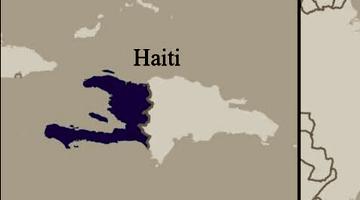 The US has a 10-Year Plan to pacify and occupy Haiti using tactics that try to hide its imperial motives. Last week, it was deleted from the website of the US Embassy in Haiti.
 Ann Garrison spoke to Professor Danny Shaw, who speaks fluent Haitian Creole and returned from his last trip to Haiti one month ago.
 "Sitting Shiva in South Florida for Our souls/slivers of democracy …" is the latest from BAR's Poet-in-Residence.
 Politicians and the liberal media cite "voter apathy" as the cause of reduced voter turnout, but the reality is that their devotion to corporate interests over those of the people creates a seeming…
 Settler colonialism has caused the destruction of indigenous lands around the world and, as a result, the environment in which we all live. The path forward is an global struggle against these forces.


