A Message to the African Political Scientist
by Benjamin Woods
This article originally appeared on Mr. Woods' web site, Free the Land.
"The first job of African political scientists is to articulate an African worldview that is distinct from their colonizers."
The United States empire made history on January 20, 2009 with the inauguration of Barack Obama, the first negro president. An unprecedented number of Africans, of all ages, entered the electoral process for the first time with a level of excitement unheard of in the author's lifetime. But it must be remembered, the phenomena of elected officials of African descent in the United States began during the Reconstruction era. The most recent set of African elected officials began in the late 1960's and early 1970's on a wave Black Power politics in majority African cities, counties, and districts. To a large extent, this group of officials oversaw the rise of the modern slave system (i.e. prison industrial complex), erosion of a domestic manufacturing base, and the introduction of crack cocaine into African communities.
At the same time, a large number of African students entered predominantly white college campuses and received degrees in political science. Similar to that generation, the current generation must examine the role of African political scientists in the African Freedom Movement. Contrary to mainstream white opinion, the new president does not represent the end of "Black politics" but, I contend, he signals a need to develop an African anti-imperialist analysis for the 21st century.
"The current generation must examine the role of African political scientists in the African Freedom Movement."
Mack Jones was an African political scientist who set forth the meaning and responsibility of his colleagues. He believed the first job of African political scientists is to articulate an African worldview that is distinct from their colonizers. Oppressed nationalities that live under colonial domination, such as Africans in the U.S., are imposed with a definition of reality that emanates from their colonizer. The acceptance of the colonizers worldview impedes Africans ability to think and act independently. Today, very few African political scientists have read the works of African intellectuals that extend to the 19th century, which includes David Walker, Martin Delany, Edward Blyden, Henry Highland Garnett, Henry McNeal Turner, Mary Ann Shadd Carey, Amy Jacques Garvey, Marcus Garvey, Harry Haywood, and Claudia Jones.
Even Obama has stated that one of his greatest inspirations is Franklin Delano Roosevelt. It is difficult to believe, as a lawyer, he did not know that in the 1930's when Africans were being lynched at a rate of every other day, FDR said and did virtually nothing. It is imperative that African political scientists not succumb to the blind faith Obama-ism that is prevalent among a large number of Africans but, instead, examine his cabinet appointments and foreign and domestic policy.
Obama's foreign policy is a continuation of western imperialism. He supports the Department of Defense's new Africa command (AFRICOM). Fifty-three African states (excluding Liberia) have stated they do not want AFRICOM based in their countries. They view AFRICOM as an attempt by the U.S. empire to re-colonize the African continent in order to control its mineral resources, particularly oil.
"African political scientists not succumb to the blind faith Obama-ism."
In addition, Obama supports the redeployment of up to 30,000 troops to the war in Afghanistan. A year after the invasion of Afghanistan the newly U.S.-installed president signed a deal to build an oil pipeline through Turkmenistan, Afghanistan, and Pakistan. Many Afghans and Pakistani people believe the real reason for the war is, not the so-called War on Terror, but to protect the new oil pipeline. Finally, Obama condemned the attacks on Mumbai, India in December but was silent when in a span of three weeks the Zionist regime that occupies Palestine killed over 1,300 Palestinians and injured over 5,000. This is because Obama has made more promises to the Zionist regime than the land of his father, Kenya, a neo-colonial state.
His domestic policy maintains the same colonial relationship between the U.S. empire and Africans in the U.S. During the course of his campaign Obama did not mention, let alone speak of abolishing, the modern system which has millions of African men and women enslaved. Moreover, when Africans like Sean Bell, Oscar Grant, and Adolph Grimes were unjustly murdered by the police he was virtually silent. And as Martin Luther King Jr. stated, "There comes a time when silence is betrayal."
Lastly, in December of 2007 Obama voted to give telecommunications companies immunity that illegally provided customers information to the U.S. government. This is extremely relevant to Africans in America who were victims of illegal surveillance during the Counterintelligence Program (Cointelpro).
"We must begin to dialogue with what Cedric Robinson calls the ‘Black Radical Tradition.'"
The author understands that the masses of Africans are feeling a great euphoria from the election of Barack Obama, but we must remain vigilant. This path (being critical of Obama) is not popular but those of us who think it correct must follow it. As African political scientists, we must begin to dialogue with what Cedric Robinson calls the "Black Radical Tradition" which begins in the maroon communities of the 16th and 17th century and continues today. As Mack Jones asserted, African "political scientists bear the responsibility of clearly and brutally unraveling the devious ways in which the American political system serves to exploit the many for the benefit of the few."
Two organizations that can continue this tradition are the National Conference of Black Political Scientists and the National Council for Black Studies. Both organizations emerged from the movement in the 1960's and 1970's therefore can offer a unique perspective on these issues. They could begin by writing organizational position papers on issues such as AFRICOM and Zionist aggression. Also, they could establish relationships with progressive and revolutionary African organizations. If African political scientists play their role correctly, they can be integral in the struggle for national liberation and self-determination.
Benjamin Woods is a Phd student in the Political Science department at Howard University and a member of the Malcolm X Grassroots Movement. He can be contacted at benjaminwoods1@yahoo.com.

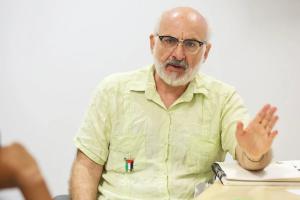 Our guest is Sam Husseini. He’s a veteran independent journalist and senior analyst at the Institute for Public Accuracy. He is now running for Congress in Maryland’s 4th district as a Green Party…
 Akili Shakur is a revolutionary activist and the wife of political prisoner Shaka Shakur. She joins us from Gary, Indiana, where some residents have been without power for more than two weeks after…
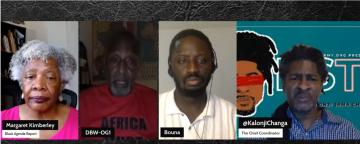 In this special broadcast, BAR Senior Columnist and Executive Editor Margaret Kimberley and Black Panther Veteran Dhoruba Bin Wahad offer an uncompromising, sharp critique of the anti-Iranian open…
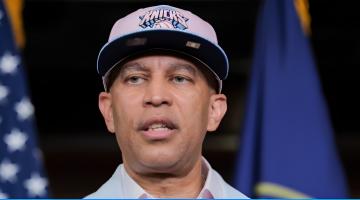 If the Democratic Party prevails in the midterm elections, Hakeem Jeffries will become the Speaker of the House of Representatives. But his decision to meet with Jared Kushner was a textbook case of…
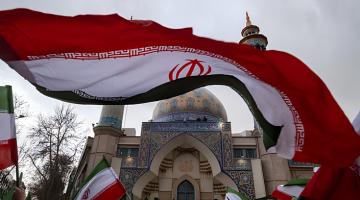 A People(s)-Centered Human Rights framework rejects the liberal abstraction that makes a false symmetry between Iranian authoritarianism and U.S. imperialism, which obscures the fact that one is a…


