Special Edition: The Jackson Rising Conference
This week, Black Agenda Radio focuses entirely on the recent “Jackson Rising” conference on cooperative economies, organized by the Malcolm X Grassroots Movement (MXGM). Organizers had hoped the event would be hosted by Chokwe Lumumba, the revolutionary Black nationalist and MXGM co-founder who was elected mayor of mostly Black Jackson, Mississippi, last June. However, Lumumba died suddenly this past February, and his son Chokwe Antar Lumumba was defeated in a special election to fill his father’s seat, in April. Despite the loss, the Jackson Rising conference proceeded as scheduled, attracting hundreds of activists from the region and around the country. BAR Managing Editor Bruce Dixon was on hand for all three days of the conference.
Allies and Enemies
Ed Whitfield, of the Fund for Democratic Communities, said the people need a vision. “It’s a vision of where we’re able to use our labor to provide enough for our loved ones and ourselves, as well as the very young, the old, the infirm, and those people who are caretakers of the community, producing love and caring for other people.”
Mississippi law “does not allow for the incorporation of cooperatives in any other sector within the state except agriculture, Melba Smith informed a popular workshop. The restrictions pose a hardship on low-income people, who must go out of state to form cooperatives and then apply for a license to operate in Mississippi, said Smith, of the Coalition for a Prosperous Mississippi.
State Sen. Jim Evans, a veteran of the Civil Rights Movement, told delegates “You have allies all over the world” – but plenty of adversaries in Mississippi. “These folks ain’t gonna change nothing unless we organize and build a majority, said Evans, who works closely with organized labor. “They don’t know what’s right, and neither do they care.”
A Question of Self-Determination
Iya Falola, a local Jackson MXGM activist, said people need to put the concept of solidarity at the center of economic thought. “The real model of economic uplift is taking the ‘I’ out of the concept,” she said. “Until we come together collectively, and are all able to benefit from our efforts, there is no solidarity in economy. It’s still capitalistic.”
The Federation of Southern Cooperatives has been working with small farmers for almost 50 years, and was one of the main participants in the Jackson Rising conference. “For African Americans, from a cultural and historical standpoint, cooperatives offer a way for people to embrace values of working together with others to enhance the total community,” said the Federation’s John Zippert.
Salima Muhammad represented Praxis, which also provide support for the conference. She believes people want to be self-determining in their economic activities. “If we can own it, then we can determine how it’s used. I think that’s where people are directing their energy.”
Michael Peck spoke for the Spain-based Mondragon Corporation, the world’s best-known cooperative, with 80,000 worker-owners and plants in 39 countries. A Mondragon venture in Argentina went bust, causing suffering among the local workers. “We went into that region as a financial investor, but we didn’t take our values with us,” said Peck. After a long, democratic review of the episode, “we decided that we would never again make an international investment without taking our values with us.”
Solidarity Economy: Essential to Transformation
There is nothing capitalistic about MXGM’s cooperative vision, said Adofo Minka. “Cooperation Jackson” emphasizes “placing the means of production in the hands of the people, and focusing more on creating livable wages and benefits for the people who work in these businesses, as opposed to one owner who is only interested in developing his own pockets.”
Bruce Dixon engaged MXGM’s Mikea Kambui, Akil Bakari and Von Anderson in a wide-ranging discussion of cooperative possibilities. One idea is to form an entertainment cooperative that Jacksonians could buy into for, say, $5 a month. “Over three months, we could come to the city with a public-private partnership to start a movie theater, here, or two theaters,” said the activists. Currently, not a single movie is located in Jackson, which had 11 theaters in the 1980s.
Gus Newport, the former mayor of Berkeley, California and close friend of Malcolm X, has long experience in cooperative ventures. “The cooperative model teaches us how to create what Martin Luther King called ‘The Beloved Community’ – how to work together, to learn to have concern for your fellow human being.”
The conference was “a foundational moment,” said Rose Brewer, a Minneapolis activist with the U.S. Social Forum and the Black Left Unity Network. “To reignite that communal, as well as cooperative, spirit is absolutely essential to any social transformation,” she said.
Sage Crump, of Artists 4 Change, said: “What moved me most was this idea of the solidarity economy, and how do we shift the way we think about our exchange of goods and services, from an individual model of give-and-get to What is the benefit for all people?” Crump is from New Orleans.
Black Agenda Radio on the Progressive Radio Network is hosted by Glen Ford and Nellie Bailey. A new edition of the program airs every Monday at 11:00am ET on PRN. Length: One hour.

 A pamphlet written 70 years ago by an exiled Black American communist reveals an African continent seething to break free from European colonization.
 The real story of the Rwandan genocide begins in 1990, when exiled Tutsis from Uganda invaded northern Rwanda, unleashing a deadly campaign that uprooted a million Hutu peasants and set ethnic tens
 Northeast, midwest, southwest, south, down south, up south, out south—south of the Canadian border—Slouched down in his cruiser, slow-rollin’ the ‘hood; Or a-
 The new Democratic administration seems determined to sabotage an agreement to end the “longest war.”
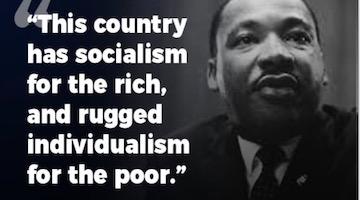 King explicitly linked the value of human dignity to the material conditions necessary to enable people to live a decent life.


