A Black Agenda Radio commentary by Glen Ford
Mouammar Khadafi was once the bane of the West, but in the past decade he has made an “accommodation” with imperialism. Since 9/11, “Khadafi has appeared more concerned with Islamic fundamentalists...than with American and European machinations.” U.S secret services may or may not have acted against Khadafi, but they will surely take advantage of any opening.
Khadafi On the Outs
A Black Agenda Radio commentary by Glen Ford
“Khadafi had clearly reached an accommodation with the United States and the rich men of Europe.”
Mouammar Khadafi strode onto the world stage when he and other young officers kicked out a King named Idris, who had charged foreign corporations the lowest prices in the world to suck out the nation’s oil wealth. That was back in 1969. By the time I had my encounter with Khadafi, 40 years later, in late October of 2009, he was still calling himself a socialist and sworn enemy of capitalism, and pushing his Green Book as a universal guide to social justice. But Khadafi had clearly reached an accommodation with the United States and the rich men of Europe. White and Asian corporate guys were everywhere in Tripoli, the capital, which was bursting at the seams with construction projects built by foreigners for foreign corporations. Libya and its six million inhabitants had become a full-fledged corporate “destination,” and Khadafi’s armed forces were in constant collaboration with the crack forces of the U.S. imperial war machine. Khadafi might tell visitors to his huge, personal tent at a military compound in the city, that he remained dedicated to destroying “capitalism,” but Washington, London and Paris didn’t seem to be worried.
Since 9/11, Khadafi has appeared more concerned with Islamic fundamentalists like those in neighboring Algeria whose suppression cost 200,000 lives than with American and European machinations. He has coordinated military maneuvers with the Americans in the Sahel region of North Africa, and worked closely with the CIA to ferret out Al Qaida-like elements. By 2008, Condoleezza Rice was in Tripoli. “I look forward to listening to the leader's world view," she said. Khadafi had already declared his love for the woman he called “Leeza,” his “darling African American woman” who, he said, “leans back and gives orders to the Arab leaders.”
“The worst possible consequence of the Libyan crisis would be for the United States to find some way to intervene.”
In 2009, the year I visited Libya with a delegation headed by former Georgia congresswoman and Green Party presidential candidate Cynthia McKinney, Khadafi had just signed an “historic” agreement on military and diplomatic cooperation. The United States African Command, Africom, and Libya pledged to work together on matters of peacekeeping, maritime security, counterterrorism and African security and stability.
Yet, there was Khadafi on television on Tuesday, looking nothing like the rather serene older man I’d encountered in the big tent 16 months ago, raging that he was under assault by some combination of the United States and Islamic militants. In that sense, his claims sounded very much like the last public words of former Egyptian President Hosni Mubarak, before he was hustled off the stage. Khadafi belittled his opponents as ignorant ingrates who knew nothing of their country's glories, or were just people high on hallucinogens. His son, Seif el Islam Khadafi, had previously threatened the Libyan people with civil war. Both father and son seemed out of touch, out of control, and on the way out. Which means the Libyan people are in danger.
But there is no greater danger to the independence and sovereignty of people's than U.S. imperialism, which has no respect for anyone's rights. The worst possible consequence of the Libyan crisis would be for the United States to find some way to intervene, in any way whatsoever. Nothing that Washington does can possibly benefit the Libyan people, who must resolve their own problems.
For Black Agenda Radio, I'm Glen Ford. On the web, go to www.BlackAgendaReport.com.
BAR executive editor Glen Ford can be contacted at Glen.Ford@BlackAgendaReport.com.

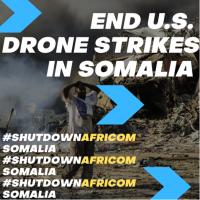 Speech by Salome Ayuak given at the International Month of Action Against AFRICOM launch event.
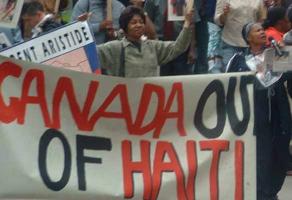 Dismantling the unelected and colonialist CORE Group is the first step to loosening the imperialist stranglehold over Haiti.
 African nations might have produced a patent free vaccine that would have benefitted the whole world.
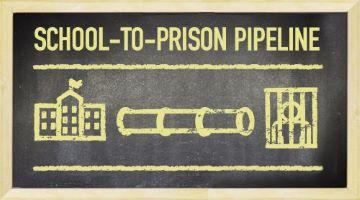 Deputies in California’s Antelope Valley are disproportionately citing Black teens for minor infractions that lead to criminal records and incarceration.
 Systemic racism is built into Canada’s prison system, but federal parties have little to offer incarcerated Black Canadians and their families.


