 by BAR executive editor Glen Ford
Barack Obama's Katrina anniversary remarks reveal a president who rails against bureaucracy while ignoring the savage race and class warfare at the heart of the (ongoing) disaster. The right of the Black poor to exist is at issue, but that's way outside Obama's radar.
Katrina’s Legacy: Poor Blacks Have No Right to “Be”
by BAR executive editor Glen Ford
“Black people's perceived right to 'place' was snuffed out, along with more than 1,000 lives.”
On the anniversary of Hurricane Katrina, President Obama used his Saturday radio address to sum up his understanding of the lesson to be derived from the disaster inflicted on predominantly Black New Orleans. “No more turf wars,” he said. What a bloodless analysis of the forced and – it is becoming clearer by the year – permanent exile of much of the population of a quintessentially Black American city!
No question, there were (and remain) Katrina turf wars aplenty, but none of the official entities battling over funds for New Orleans ever fought for the interests of the African American poor and utterly dispossessed. Hundreds of thousands were hastily scattered to the four winds by common agreement among competing agencies, all of whom regarded the Black exodus as a god-send to be perfected, not corrected. First the “turf” must be cleared of the unwanted human presence; then, the battles could begin in earnest over who would next inherit the land and cash the “reconstruction” checks.
Black people's perceived right to “place” was snuffed out, along with more than 1,000 lives. Katrina meant that, not only do poor Blacks have no “right to return,” they have no right to “be.” Certainly, if such a right did not exist in New Orleans, where the entire world had witnessed the mass displacement of African Americans by nature and their own government, then it exists nowhere.
“The disaster served to crystalize as national policy the longstanding practice of ethnic cleansing.”
Through myriad actions ranging from the petty to the draconian, the various governmental structures of the United States have collectively set in stone the nullification of Black people's right to place – the true and awful legacy of Katrina. The disaster served to crystalize as national policy the longstanding practice of ethnic cleansing, once called “Negro Removal,” that is sweeping out urban America at an ever-quickening pace. New Orleans' weather-triggered but government-engineered purge of the Black poor was simply a fast-forwarded version of the hyper-gentrification at work everywhere that capital asserts its right to “place.” It is a right that often appears to augment traditional white folks' rights to occupy the choicest locations, but which follows its own dynamic and can be claimed by economically mobile Black folks, as well. From some Black angles, this hardening of geo-economic boundaries looks like freedom: the freedom to become as distant as possible from the poor of your own race.
And so we find that the Black “Mecca,” Atlanta, is at least as relentless as New Orleans in demolishing the last of its public housing stock, without need of flooding as an excuse. Meanwhile, the Black misleaders of Atlanta, who have done all in their power to purge the city of the Black poor, worry that white newcomers will vote them out of office. They have met the contradiction, and it is themselves.
President Obama is constitutionally incapable of recognizing the central crime of Katrina – the corralling and subsequent dispersal of the poor to who-cares-where – because he is bent on perpetuating the crime. Thus, in his radio address, Obama cited New Orleans' status as the nation's fastest growing city, sounding for all the world like a mayor who has just bulldozed the last “blighted” neighborhood adjacent to downtown. Then, with awesome banality, the president reminded listeners that “with every tragedy comes the chance of renewal.”
Renewal for whom? Turf wars over what? The Black poor have been displaced from this conversation, exiled beyond the pale of national policy consideration.

 In this week’s segment, we focus on Africa. We hear about the Black Alliance for Peace Month of Action Against AFRICOM and about African governments that cooperate with the Trump administration's…
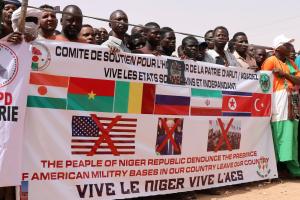 Netfa Freeman and Margaret Kimberley are among the Co-Coordinators of the Black Alliance for Peace Africa Team.
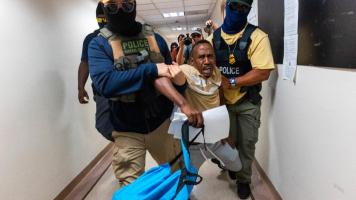 Our guest is Abayomi Azikiwe, editor of Pan African Newswire.
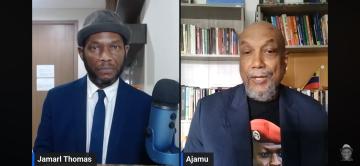 Ajamu Baraka, BAR Editor and Columnist, joined Jamarl Thomas to discuss U.S. decline into overt fascism, the proxy war in Ukraine, and the regime change campaign against Venezuela.
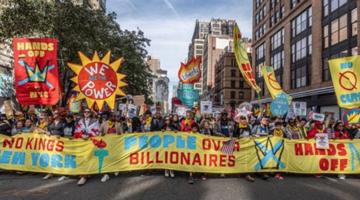 The most recent No Kings march will hopefully be the last. A Democratic Party get out the vote effort is a show that obscures and obstructs the real work of organizing.


