by BAR editor and senior columnist Margaret Kimberley
Too much forgiveness is an unhealthy thing. It allows the excessively forgiven parties to believe that they can do no wrong. Of course, there have been times when Negroes had little choice but to forgive white people – or pretend to forgive – or die. Unfortunately, “in the 21st century we have reverted to grateful Negro status, even when our loved ones are killed.”
Freedom Rider: Forgiving White People
by BAR editor and senior columnist Margaret Kimberley
“We are taught to never blame white people for anything, even when they are clearly blame worthy.”
A line in a poem says “to err is human, to forgive divine.” We hear constant exhortations to forgive and forget and let bygones be bygones. Most religions teach forgiveness as a major tenet. Literature, old adages and religious beliefs may seem harmless, but behaving as if forgiveness is an unalloyed good can have dangerous consequences, especially for black people.
Black people have every reason to be full of righteous indignation. Our history in this country is a litany of one atrocity after another. Two hundred years of slavery ended with the Civil War which was then followed by the defeat of Reconstruction and nearly 100 more years of segregation and Jim Crow, America’s apartheid. An all too brief liberation movement was undermined by a system of mass incarceration which has gone on for the last forty years.
A constant of black life has been the establishment and maintenance of lynch law. The ghoulish spectacles of blood thirsty crowds may be a thing of the past, but lynch law was never repealed. As the Malcolm X Grass Roots Movement informed us, every 28 hours a black person is a victim of extra judicial murder carried out by police, security and vigilantes.
In the early morning hours of September 14, 2013 Jonathan Ferrell was killed by a police officer in Charlotte, North Carolina. He had survived a serious car accident and in all probability knocked on the door of a nearby home because he was seeking assistance, only to have the homeowner call police. We can only guess what happened next because he is dead and can’t explain what he did or why a police officer shot him ten times.
“Every 28 hours a black person is a victim of extra judicial murder carried out by police, security and vigilantes.”
Ferrell’s execution was bad enough, but the public statements made by his family have made a mockery of the justifiable anger expressed about his murder. Both his mother and his fiancée have said that they forgive his killer, police officer Randall Kerrick. Ferrell’s fiancee Cache Heidel said, “I’ve forgiven him. I'm not hateful. I understand it. He was scared. It just hurts.” Georgia Ferrell, the dead man’s mother, made an even more bizarre statement. "You caused a great loss to my heart. You took a piece of my heart that never can be put back, but I do forgive you. I truly forgive you and wish you the best with your life and turning it over to God."
It may seem unkind to criticize grieving people, but their words have an impact on all black people who are at risk of experiencing the same fate. No one should be silent about how any one person reacts to these modern day lynchings. The seemingly inexplicable behavior is caused by the same thing that killed Jonathan Ferrell. White supremacy teaches that white people are in the right and black people are not only assumed to be wrong but deserving of any treatment that whites should choose to mete out. The result is that black people get messages both overt and subtle which tell them that white people must always be forgiven and their actions understood.
The era when black people were allowed and indeed encouraged to show their anger is sadly long past. For several decades we have been told to “stop blaming white people” and pull ourselves up by bootstraps. These foolish words, sometimes spoken by black people themselves, have given white people cover to do anything and made black people incapable of showing their wrath. We are taught to never blame white people for anything, even when they are clearly blame worthy. These women did not feel secure expressing their anger at the killer or even simply expressing their grief. Instead they felt a powerful need to publicly forgive the unforgivable.
“Black people get messages both overt and subtle which tell them that white people must always be forgiven and their actions understood.”
We have been thrown back to a time when white people were to be feared and their misdeeds forgotten because there was no recourse for their wrong doing. Any complaint, however justified, could quite literally be deadly. Now in the 21st century we have reverted to grateful negro status, even when our loved ones are killed.
Georgia Ferrell felt compelled to wish her son’s the killer the best as if he had committed a minor offense and not killed her child. "He took my son from me, but I can only stand here and tell you that I believe God is the one listening to me right now and God would want me to forgive. If I don't forgive, it will be on me forever."
What Mrs. Ferrell should have said is that she feared her anger more than anything else. She fears that it will consume her because it is doubtful that Kerrick will ever be punished for his actions even though he has been charged with voluntary manslaughter.
Ms. Heidel and Mrs. Ferrell know the unwritten rule. “Thou shalt not be angry with white people.” They would be better off if they did hate officer Kerrick and if they stopped praying for him. We would all be better off if they said they were angry and used that anger as a tool which would ultimately help them and the 300 other black families who will have the same experience this year. Ferrell’s family isn’t the last one to suffer through this grief but they should be the last ones to express anything other than a demand for justice.
Margaret Kimberley's Freedom Rider column appears weekly in BAR, and is widely reprinted elsewhere. She maintains a frequently updated blog as well as at http://freedomrider.blogspot.com. Ms. Kimberley lives in New York City, and can be reached via e-Mail at Margaret.Kimberley(at)BlackAgendaReport.com.

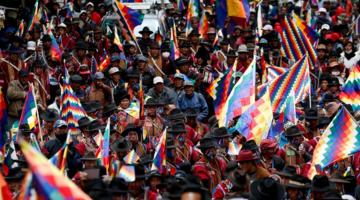 Former Bolivian president Evo Morales Ayma spoke with Black Agenda Report correspondent Clau O’Brien Moscoso.
 The World Cup is meant to be a celebration of global unity, not a propaganda shield for a superpower waging genocide abroad and running detention gulags on its own soil.
 The immigrants who revolted inside the Delaney Hall immigration jail are not criminals but prisoners of war, and their actions are those of resistance against a fascist detention system.
 Since early May, the World Health Organization and the African Centers for Disease Control and Prevention have been working to contain the spread of a rare and virulent strain of Ebola virus disease.
 A critical analysis of the U.S. backed social media "influencer" war propaganda campaign against Cuba as it struggles against a criminal siege.


