by BAR executive editor Glen Ford
“Marikana was the great shock to the national consciousness, and Mandela’s death brought a final end to the pretense of social transformation.” In the transition from apartheid, the ruling African National Congress chose Black capitalism and neoliberalism. But, trade unionists plan to create a workers party that will fight for implementation of the Freedom Charter – and socialism.
Freedom Charter is Key to New Struggle for South Africa
by BAR executive editor Glen Ford
“NUMSA general secretary Irvin Jim calls for formation of a genuine workers party that will fight to fulfill the demands of the Freedom Charter.”
Nelson Mandela’s voice filled the hall at New York City’s historic Riverside Church, last Saturday. A film showed Mandela’s speech of July 26, 1991, in Matanzas, Cuba, the African National Congress deputy president’s first trip abroad since his release from imprisonment, the year before. “Our goals remain achievement of the demands of the Freedom Charter, and we will settle for nothing less than that,” said Mandela, with Fidel Castro standing nearby.
Mandela thanked the Cuban people for their heroic sacrifices in defeating the armed forces of the apartheid regime, at Cuito Cuanavale, Angola, in 1988. Twice more in the speech, Mandela mentioned the Freedom Charter, the ANC’s 1955 promise to the people. He cited the Charter’s rejection of “the racist state” that still ruled South Africa, and quoted the document’s declaration that “The people shall govern.” But the man who would assume the presidency of South Africa four years later made no mention of the Freedom Charter’s core economic demands: the redistribution of land and nationalization of the mines, heavy industry and banking – steps the Cubans had taken soon after the triumph of their revolution.
By the time he took the stage at Matanzas, Mandela and his African National Congress colleagues had already discarded the key elements of the Freedom Charter except those that called for a government elected by a common franchise. Ronnie Kasrils, a veteran of the ANC’s armed wing who joined the cabinet of the new ANC government in 1994, described “How the ANC's Faustian pact sold out South Africa's poorest” in an article published in The Guardian, in June of 2013. “From 1991 to 1996,” Kasrils wrote, “the battle for the ANC's soul got under way, and was eventually lost to corporate power: we were entrapped by the neoliberal economy – or, as some today cry out, we ‘sold our people down the river.’”
“Mandela made no mention of the Freedom Charter’s core economic demands: the redistribution of land and nationalization of the mines, heavy industry and banking.”
While he still breathed, Mandela’s symbolic aura shielded the ANC from the harsh verdict of history. Then, in 2012, as “Madiba’s” health began to fail, police massacred 34 workers demanding higher wages at a platinum mine in Marikana – the worst state violence since the white regime’s slaughter of Black demonstrators at Sharpeville, in 1960. The ANC government was no less rabid than its white predecessor in denouncing the dead as the agents of their own destruction, for having broken away from the giant mineworkers union, a cornerstone of the Congress of South Africa Trade Unions (COSATU), which is the third leg of the nation’s ruling triumvirate, along with the ANC and the South African Communist Party (SACP).
Today, the once 300,000-strong mineworkers union has lost at least half its membership to more militant rivals. No wonder, since its founding secretary, Cyril Ramaphosa, went on to become a fabulously wealthy ($675 million, according to Forbes) member of the board of directors of the multinational corporation that the Marikana miners were striking against, and a high ranking official in the ruling African National Congress. Emails sent by Ramaphosa during the Marikana crisis indicate he encouraged the government to make an example of the strikers.
The National Union of Metalworkers (NUMSA), now the biggest trade union, with 380,000 members, has announced it will not support the ANC in coming elections, and urges COSATU to leave the ruling alliance. Instead, NUMSA general secretary Irvin Jim calls for formation of a genuine workers party that will fight to fulfill the demands of the Freedom Charter, and for “a new United Front that will coordinate struggles in the workplace and in communities, in a way similar to United Democratic Front of the 1980s” – the period when the ANC was banned and largely in exile.
“It took Marikana and Mandela’s death to bring contradictions to a head.”
The metalworkers, backed by eight of COSATU’s 19 unions, are demanding a special congress to battle it out with ANC loyalists. NUMSA’s Irvin Jim derided ANC secretary general Gwede Mantashe, who pretended to act as a mediator in the COSATU dispute, as a man who “feigns ignorance of neoliberalism” and “talks about cushioning the working class, but he does not even mention what class force is responsible for the suffering of our class. This is because some of [his] colleagues in [the] top six of the ANC are capitalists.”
Capitalists like Cyril Ramaphosa, the most prominent beneficiary of BEE, Black Economic Empowerment, the ANC’s alternative to the socialist path set forth in the Freedom Charter. Not only did the ANC and the South African Communist Party choose the neoliberal path, in the critical first half of the 90s, they set the stage for creation of a Black capitalist class to be grafted onto existing corporate structures. The economic ruling class was, to a degree, racially integrated, while the ruling party, the ANC, was converted to capitalism. The revolution was defeated – or, rather, never begun – and everybody knew it, but it took Marikana and Mandela’s death to bring contradictions to a head.
In addition to the metalworkers, the nine dissident unions, who probably represent a majority of union members in South Africa, are: the Communication Workers' Union, Democratic Nurses Union of South Africa, the Food and Allied Workers' Union, Public and Allied Workers' Union of South Africa, South African Commercial and Catering Workers' Union, South African Football Players' Union, South African Municipal Workers' Union and the South African State and Allied Workers Union.
COSATU’s current leadership, which is all but inseparable from the ANC/SACP, refuses to call a special congress – despite the fact that COSATU’s constitution requires such a congress if demanded by one-third of affiliated unions. Instead, they threaten to suspend the metalworkers, which would almost surely split COSATU right down the middle. ANC leadership has long treated COSATU as a mere appendage to its rule, and would prefer a paralyzed union confederation to a politically independent one.
However, the arrogance of the new Black capitalists may prove their undoing. For many millions of South Africans, the psychologically break with the ANC has already happened. Marikana was the great shock to the national consciousness, and Mandela’s death brought a final end to the pretense of social transformation. South Africa sees itself much more clearly: the most unequal country in the world, in which the struggling poor are said to stage more demonstrations than any other nation on earth – out-protesting the Chinese! – confronting a killer police force that was never weaned from its apartheid mission, to suppress the Black lower classes.
It is also the South Africa where the Freedom Charter is a living memory, the socialist document that legitimized the ANC as the post-apartheid ruling party. Mandela was compelled to cite the Freedom Charter in Cuba, even as he and his colleagues were discarding it, at home.
The Freedom Charter is South Africa’s unfinished business. The ANC, having repudiated it, in word and deed, must now be forced to run against the Freedom Charter, through the formation of a workers party opposition. We will then likely see a split in the ANC, itself – which is necessary to allow the honest elements within its ranks to escape the institutional grasp of Black capitalists and opportunists.
The Freedom Charter has been dormant for a quarter century, during which time multinational capital has been reinforced by a Black comprador class, headquartered in the African National Congress. It is now impossible to defeat multinational capital’s grip on South Africa, without also confronting the party that claims to have “liberated” the country. Fortunately, the process is well underway.

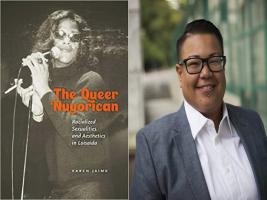 This week’s featured author is Karen Jaime. Jaime is Assistant Professor of Performing and Media Arts and Latina/o Studies at Cornell University. Jaime’s book is The Queer Nuyorican: Racialized…
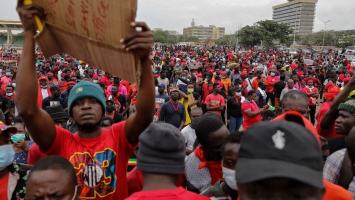 Ghana has initiated talks with the International Monetary Fund to seek a potential bailout amid a major economic crisis. This has been rejected by the Socialist Movement of Ghana and trade unions who…
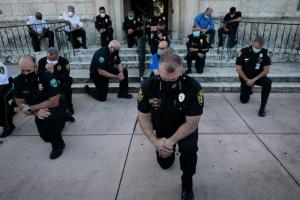 US police departments spend tens of millions of dollars every year to manipulate the news, flooding the discourse with “copaganda.” These aggressive tactics give the public a distorted view of what…
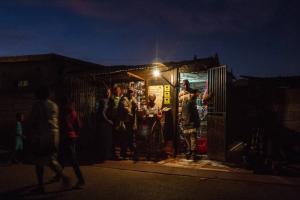 Behind rolling power cuts loom deep-seated socioeconomic issues worsened by the rich countries of the world.
 For almost two weeks, tens of thousands of Panamanians have been taking to the streets across the country protesting the cost of living crisis and lack of of response and attention from the…


