A Black Agenda Radio commentary by Glen Ford
Under drastically expanded rationales of national security and crime prevention, the FBI has empowered itself to massively penetrate and gather information on whole communities. In FBI-speak, these are called “domains” – “large geographic and social spaces in which national security demanded that the Bureau make itself acutely ‘aware.’” Wholesale targeting of these communities – an “industrial-strength” form of profiling – is justified on the assumption that “Blacks, Muslims (especially Black Muslims) and Latinos are more prone to crime and acts of terror.”
FBI “Mapping”: Racial Profiling on a People-Wide Scale
A Black Agenda Radio commentary by Glen Ford
“A Black Separatist threat turned into an investigation of the growth characteristics of Blacks in the Atlanta area.”
Until the events of 9/11, Black America seemed to be winning lots of battles in the fight against racial profiling. The term “Driving While Black” had become almost a household word due to heavy media exposure of wildly disproportionate stops of Black drivers by police on Interstate highways. Racial profiling had become politically and socially unacceptable, with few public advocates even among law and order Republicans. And then the Twin Towers came down. Almost instantaneously, racial profiling was back, with a vengeance – directed most dramatically against people who “appeared” to be Muslim, whatever that looks like, but with renewed vigor against African Americans, the historical targets. The FBI, which was never a respecter of the rights of darker peoples, repositioned itself to aggressively pre-empt any threat to national security. That means going after people even when there is no evidence of a crime. Although it remained against the rules for FBI agents to launch investigations based solely on race, religion of ethnicity, those factors could be taken into account. It was a loophole big enough to drive a busload of Knights of the Ku Klux Klan through. By asserting that certain racial, religious and ethnic groups – Blacks, Muslims (especially Black Muslims) and Latinos – were more prone to crime and acts of terror, the FBI cold justify all manner of methods to massively penetrate these groups in the interest of national security.
The vocabulary changed to suit the mission. Ethnic, racial and religious communities became “domains” in FBI parlance, large geographic and social spaces in which national security demanded that the Bureau make itself acutely “aware.” Thus, the new strategy was called “domain awareness” – meaning, the FBI’s job was to learn everything about the people who lived in these ethnic, religious and racial “domains.” All that was required to launch massive intelligence gathering campaigns against, say, Black people in the state of Georgia, Arabs in the Detroit area, Chinese and Russians in the San Francisco Bay Area, or almost any group in New York City, was the invocation of a vague criminal or national security “threat.”
“The Bureau is studying racial and ethnic ‘behaviors’ and ‘facilities.’”
Like magic, threats started appearing all over the place. In October 2009, the Atlanta office of t he FBI sent out a threat “alert” about supposed “Black Separatist Don't Map Me or My Community
For Black Agenda Radio, I'm Glen Ford. On the web, go to BlackAgendaReport.com.
BAR executive editor Glen Ford can be contacted at Glen.Ford@BlackAgendaReport.com .

 The ineffective and unpopular UN Mission to Haiti must end.
 Under imperialism resource wealth can become a curse, such is the case with the EACOP pipeline in East Africa.
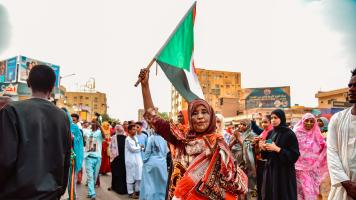 In the aftermath of the violent repression of protesters on June 30, sit-ins have been organized in various parts of Sudan even as the military junta tries to consolidate power.
 The U.S. is empire is in a state of crisis, creating chaos around the world and contradicting its own goals.
 Liberation struggles are not fought only on the battlefield. The African Party for the Independence of Guinea-Bissau and Cape Verde (PAIGC) left a legacy of educational decolonization.


