by Mark P. Fancher
The U.S. Africa Command, AFRICOM, becomes more entrenched on the continent by the day. American drones bases dot the landscape and U.S. troops interact constantly with their African counterparts. Africa has collaborated in its own occupation. “There has been increasing cooperation between African militaries and U.S. forces, and it has allowed AFRICOM to gain a more secure foothold on African soil.”
Expected Budget Cuts Won’t Cure the Deadly AFRICOM Disease
by Mark P. Fancher
”There are an estimated 5,000 U.S. troops deployed in Africa.”
Although the cancerous U.S. military presence in Africa has radically metastasized in recent years, funds for these operations may be in jeopardy because of the Congressional budget process. Reuters reports that U.S. Africa Command (AFRICOM) may lose as much as $40 million in 2014. This represents more than a tenth of the command’s budget.
The potential reduction in funds does not necessarily reflect a change in U.S. military policy. Rather it is mandated by government spending limitations that are called “sequestration.” While those who regard AFRICOM as a menace may hope the budget restrictions will slow the wild, unrestrained campaign to fully militarize Africa, there may actually be little reason for optimism.
During AFRICOM’s early years, the command’s leaders adamantly denied accusations that the U.S. was commencing a full-scale military occupation of Africa. A 2009 Congressional Research Service memorandum said: “[The Defense Department] has stressed that there are no plans to have a significant troop presence on the continent.” Yet, a mere five years later, there are an estimated 5,000 U.S. troops deployed in Africa. Not only are even more soldiers on the way, the New York Times reports that the U.S. is mobilizing 13,000 troops in Italy for the specific purpose of launching instantaneous raids into Africa to respond to crisis situations.
The meddling and intervention have not been without practical costs. As the U.S. pursued its maniacal, obsessive campaign to overthrow the government of Libya’s Muammar Qaddafi, the CIA and AFRICOM acted on behalf of rebel groups. Many of the militias were undisciplined, armed racist bands – some of whom fought under the name “Brigade for Purging Slaves/Black Skin.” When these armed mobs carried out genocidal acts of terror, the U.S. apparently looked the other way and offered no resistance as rebel forces took control of Libya’s government reins. Although the U.S. has what is described as a “complicated, fragile relationship” with the new government, the New York Times reports that the U.S. military is nevertheless considering a plan to develop a conventional army of between 5,000 and 7,000 soldiers for Libya.
”The U.S. is mobilizing 13,000 troops in Italy for the specific purpose of launching instantaneous raids into Africa to respond to crisis situations.”
The New York Times article says: “[Admiral William McRaven] acknowledged that there would be some risk in training security forces in a country where militias have shifting ties, and that some who entered the training program might have questionable backgrounds. In particular, he cautioned that it would be difficult to vet fully all Libyan personnel who might be trained by Americans. ‘There is probably some risk that some people we will be training do not have the most clean record,’ Admiral McRaven said. ‘At the end of the day, it is the best solution we can find to train them to deal with their own problems.’”
AFRICOM has always contended that it is in Africa only to help Africans “deal with their own problems.” However, AFRICOM has not walked that talk. It has instead sought to intervene directly. In addition to the deployment of thousands of U.S. troops in Africa there are plans to sink $1.2 billion into improvements to the U.S. base in Djibouti over the next 25 years – notwithstanding immediate budget concerns. Also, AFRICOM itself is not merely a handful of officers lurking in the shadows feeding directives to African soldiers. It has instead become a complex entity with considerable personnel. The AFRICOM structure includes:
*U.S. Army Africa (USARAF)
*U.S. Air Forces Africa (AFAFRICA)
*Combined Joint Task Force – Horn of Africa (which alone has 2,000 military personnel stationed in Djibouti.)
*U.S. Marine Corps Forces Africa
*U.S. Naval Forces Africa
*U.S. Special Operations Command Africa
The spread of this U.S. military disease may seem unstoppable. But still available to AFRICOM’s opponents is the remedy of non-cooperation. From the outset countries across the continent refused to allow AFRICOM to establish headquarters in Africa. In fact, African governments could have cold-shouldered AFRICOM right back to the Pentagon if they had refused to yield. But instead there has been increasing cooperation between African militaries and U.S. forces, and it has allowed AFRICOM to gain a more secure foothold on African soil.
Because African governments have not stood firm, AFRICOM’s decline may ultimately depend upon a refusal by the broad masses of Africa’s people to have anything to do with the U.S. armed forces. If the youth of Africa and her Diaspora refuse to utter the phrase “present and reporting for duty” when recruited by U.S. military officers and their African collaborators, AFRICOM could very well find its toxic, diseased self without a continent to torment.
Mark P. Fancher is an attorney who writes frequently about the U.S. military presence in Africa. He can be contacted at mfancher@comcast.net.

 SCOTUS, Roe v Wade and left politics, Racism in UK immigration policy, and Workers' Struggle in Haiti in this week's Black Agenda Radio.
 Pascal Robert is co-host of the This is Revolution podcast. He is also a long-time contributor to Black Agenda Report as well as to Newsweek. He joins us from Miami, Florida to discuss the recent…
 Glenroy Watson is a Pan-African trade unionist who is Secretary of the Global Afrikan Congress, UK Chapter. He joins us to discuss the continuation of Hostile Environment immigration policies in the…
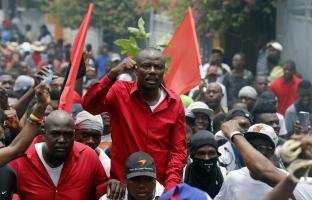 Dahoud Andre is a member of KOMOKODA, the Community to Mobilize Against Dictatorship in Haiti, and host of Eritye Papa Desalin, the Heirs of Jean Jacques Dessalines, a daily Haitian community radio…
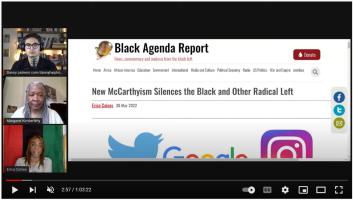 Erica Caines, Editor of Hood Communist and Coordinating Committee Member for the Black Alliance for Peace, joins the stream to discuss the New McCarthyism and its implications.


