by BAR executive editor Glen Ford
If Dr. King were alive today, there might be a Black president, but he or she would certainly not get MLK’s support if he behaved like Barack Obama. Dr. King would oppose Obama’s wars, “make Wall Street scream, and attempt to render the nation ungovernable under the dictatorship of the Lords of Capital.”
Don’t You Dare Conflate MLK and Obama
by BAR executive editor Glen Ford
“Had King survived, his break with Obama would have come early.”
Back in 1964, under prodding from a BBC interviewer, Dr. Martin Luther King Jr. predicted that a Black person might be elected president “in 25 years or less.” Four years later, shortly before his assassination, King confided to actor/activist Harry Belafonte that he had “come to believe we're integrating into a burning house." We now see that the two notions are not at all contradictory. At least some African Americans have achieved deep penetration of the very pinnacles of white power structures – integrating the White House, itself – while conditions of life for masses of Black folks deteriorate and the society as a whole falls into deep decay.
The fires lit by the “giant triplets of racism, extreme materialism, and militarism” that Dr. King identified in his 1967 “Beyond Vietnam: Breaking the Silence” speech are consuming the world, now stoked by a Black arsonist-in-chief. Domestic poverty hovers only a fraction of a percentage below the levels of 1965, with “extreme poverty” the highest on record. Black household wealth has collapsed to one-twentieth that of whites. Today, more Black men are under the control of the criminal justice system than were slaves in the decade before the Civil War, according to Michelle Alexander, author of The New Jim Crow.
The intervening years have shown that Dr. King’s 1960s visions were not in conflict: the rooms at the top floors of the national house may have been integrated, but the building still burns.
The deepening crisis of capitalism, the triumph of Wall Street finance over industrial capital, the increasing imperial reversion to international lawlessness in a desperate bid to maintain global supremacy – all this was predictable under the laws of political economy. Had the assassin’s bullet not found him, Dr. King would have continued his implacable resistance to these unfolding evils, rejecting Barack Obama’s invasions, drones and Kill Lists with the same moral fervor and political courage that he broke with Lyndon Johnson over the Vietnam War. Absolutely nothing in King’s life and work indicates otherwise.
“The very notion of a grand austerity bargain with the Right would have been anathema to MLK.”
One school of thought holds that corporate servants like Obama could not have taken root in Black America if Dr. King, Malcolm X and a whole cadre of slain and imprisoned leaders of the Sixties had not been replaced by opportunistic representatives of a grasping Black acquisitive class. In any event, had King survived, his break with Obama would have come early. Surely, the Dr. King who, in his 1967 “Where Do We Go from Here” speech called for a guaranteed annual income would never have abided Obama’s targeting of Social Security, Medicare and Medicaid in the weeks before his 2009 inauguration. Forty-five years ago, King’s position was clear: “Our emphasis must be twofold: We must create full employment, or we must create incomes.” The very notion of a grand austerity bargain with the Right would have been anathema to MLK.
Were Martin alive, he would skewer the putative leftists and their “lesser evil” rationales for backing the corporatist, warmongering Obama. As both a theologian and a “revolutionary democrat,” as Temple University’s Prof. Anthony Monteiro has described him, MLK had no problem calling evil by its name – and in explicate triplicate. His militant approach to non-violent direct action required him to confront the underlying contradictions of society through the methodical application of creative tension. He would make Wall Street scream, and attempt to render the nation ungovernable under the dictatorship of the Lords of Capital. And he would deliver a withering condemnation of the base corruption and self-serving that saturates the Black Misleadership Class.
He would spend his birthday preparing a massive, disruptive action at the Inauguration.
BAR executive editor Glen Ford can be contacted at Glen.Ford@BlackAgendaReport.com.

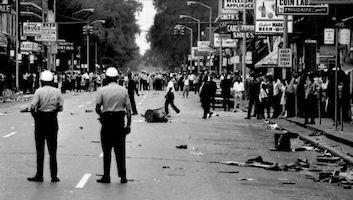 The police as they exist today need to be abolished, there’s no question. “Diversity doesn’t change the fundamental dynamics of policing.”
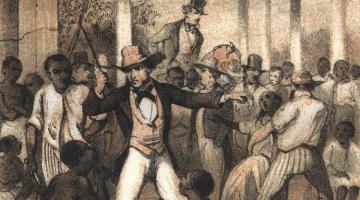 Much of what is called the “left” still insists that the American “revolution” of 1776 is “unfinished,” when history shows that white supremacy was the intended result.
 Most people contribute to injustice not as direct perpetrators but as indirect participants who enable, perpetuate, benefit from, and inherit histories of violence and contemporary systems of explo
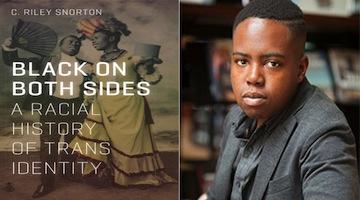 The inhabitation of the un-gender-specific and “fungible” also mapped the affective grounds for imagining other qualities of life and being for those marked by and for captivity.
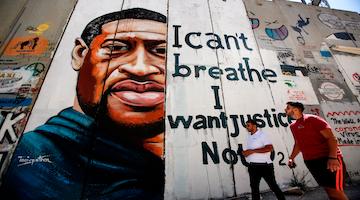 The surge of attention to the Israeli occupation is unimaginable without last year’s “George Floyd” protests.


