by Sikivu Hutchinson
On a host of fronts, the counter-revolution is on the offensive against “the revolutionary right of women to control their own destinies.” Under U.S. House legislation, anti-abortion booby-traps are embedded in the tax code, as entrapments. “Women who are audited could be forced to reveal why and how they had an abortion, further ensuring Big Brother’s reign over their bodies and destinies” – a horrific combo of “sexual terrorism and state power.”
Defending ‘Our Mother’s Gardens’
by Sikivu Hutchinson
“Whenever a rape case becomes high profile, the inevitable questions about the victim’s reputation, race, whereabouts, and alleged complicity in the assault are trotted out.”
In her landmark work In Search of Our Mother’s Gardens, Alice Walker wrote: “What did it mean for a black woman to be an artist in our grandmother’s time? Our great-grandmothers’ day? Did you have a genius of a great-great-grandmother who died under some ignorant and depraved white overseer’s lash? Or was her body broken and forced to bear children (who were more often than not sold away from her)—eight, ten, fifteen, twenty children—when her one joy was the thought of modeling heroic figures of rebellion?” Many of my students do not know who Walker is. But as they listen to me read her words during a discussion of Women’s History Month they are quiet as death, contemplative, and, perhaps, newly enflamed. As students of female sacrifice, many of them know the savage politics behind her canvas. They are intimately aware of the blood price women of color must pay to be free in this so-called post-feminist society in which white male lawmakers trivialize sexual assault with dangerous tautologies like “forcible rape.”
Recently the mainstream media buzzed with news reports that a Libyan woman had reported being gang-raped to a group of foreign correspondents. A MSNBC reporter described the victim as middle aged, well-spoken and respectable (the victim was actually estimated to be in her 20s or 30s), implying that her credibility was beyond reproach. As a “respectable,” upstanding woman, her rape would surely be an affront to her community. Preemptive reference to rape victims’ social station is a now familiar device in the rape reporting game. Over the past few weeks, the gang rape of an 11 year old Latina girl also made headlines, eliciting controversy over the girl’s portrayal in both mainstream media and in the community where the assault occurred. Whenever a rape case becomes high profile, the inevitable questions about the victim’s reputation, race, whereabouts, and alleged complicity in the assault are trotted out. Yet seldom is there any analysis of the sociopolitical conditions that legitimize rape and the connect-the-dots rape reporting game. And seldom is there any analysis of what gives men license to violently occupy women’s bodies. There is never any connection made between this kind of sexual terrorism and state power. Hence, these connections are especially urgent now given the unrelenting wave of anti-choice anti-abortion legislation that has swept the nation since the midterm elections.
“Seldom is there any analysis of the sociopolitical conditions that legitimize rape and the connect-the-dots rape reporting game.”
South Dakota recently passed a law requiring pregnant women to wait three days before they made a decision about terminating their pregnancies. Under the new mandate, championed by the state’s governor, women must receive counseling from a doctor before they have an abortion. It is the only state in the nation to impose such a requirement. Other pending legislation includes requiring that women receive ultrasounds before they make a decision to terminate. Health care reform foes have also spearheaded legislation that restricts private insurers who participate in new government mandated health exchanges from providing abortion coverage.
One of the most pernicious civil liberties’ rollbacks is HR.3, the House-sponsored legislation that would give the I.R.S. the right to question women who had abortions about whether they became pregnant by rape or incest. The bill has been dubbed “Stupak on Steroids,” after Democratic Congressman Bart Stupak, who crusaded against abortion coverage under health care reform. According to Mother Jones magazine, the bill “extends the reach of the Hyde Amendment—which bans federal funding for abortion except in cases of rape, incest, or when the life of the mother is at stake—into many parts of the federal tax code. In some cases, the law would forbid using tax benefits—like credits or deductions—to pay for abortions or health insurance that covers abortion.” Women who are audited could be forced to reveal why and how they had an abortion, further ensuring Big Brother’s reign over their bodies and destinies.
There is a connection between this kind of state-sponsored terrorism and the brutal occupation of women’s bodies through rape. Yet in the U.S., the term terrorism is only used when dark-skinned racial others are the perpetrators of “strategic” geopolitical violence. Violence against women can be isolated to aberrant male predators, not the predatory terroristic human rights violations of the state.
“Validation through a baby that one cannot take care of is ok, while validation through sex is not.”
Recently a student in my Women’s Leadership Project group expressed her vehement opposition to abortion. She argued that a woman who has sex should be prepared to accept the potential consequence of an unplanned pregnancy. Like most young women she was taught that going through with an unplanned unwanted pregnancy is a supremely moral decision. After all, self-sacrifice under inhumane conditions is what is expected and required of women. Validation through a baby that one cannot take care of is ok, while validation through sex is not. In this regime, the consequence of pregnancy for women is a biologically determined life sentence, one that males cannot and will not be forced to serve. Women who don’t agree to this life sentence are immoral, rather than the society that does not provide for every child regardless of class or race. Some of the most vitriolic responses I’ve ever gotten to my writing were from anti-abortion foes, primarily men, who see a white supremacist plot behind black women’s support for abortion. But it is not white supremacy that dictates black women’s allegiance to the legacy of female ancestors who could not control their own destinies. And this is perhaps the profound power of Walker’s work. In search of her mother’s garden, she “found (her) own.” Honoring the great grandmothers whose artistry and personhood were denied symbolizes the revolutionary right of women to control their own destinies, tend their own gardens, to ensure that terrorism cannot continue to disguise itself as legitimacy and law.
Sikivu Hutchinson is the author of Moral Combat: Black Atheists, Gender Politics, and the Values Wars (Infidel Books).

 As the White House and 10 Downing Street deny genocide in Gaza, both imperialist states bomb Yemen, the most impoverished country in the West Asia region.
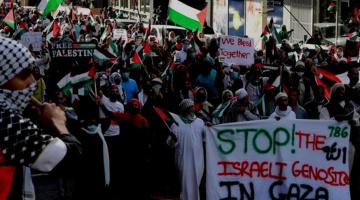 The International Coalition to Stop Genocide in Palestine renews its call for support of South Africa's charge of genocide against Israel in the International Court of Justice.
 One hundred years since Lenin’s death, Nigerian socialist Abiodun Olamosu describes the revolutionary's influence on his own political development.
 For the third time a federal court has dismissed a case targeting the U.S. Campaign for Palestinian Rights' support for the 2018-19 Great March of Return protests in Gaza.
 South Africa makes the case against Israel at the ICJ, events in Gaza, the passing of Sekou Odinga.


