by Norman (Otis) Richmond aka Jalali
The Black Music Association was formed in 1979, but not all chapters supported the boycott of racist South Africa in the Seventies and Eighties. The Toronto and New York chapters shunned the racist regime.
Celebrating 35 years of Black Music Month
by Norman (Otis) Richmond aka Jalali
“It was our intention to plug African-Canadian music makers into the international music market.”
Black music has been international since the Fisk Jubilee Singers, a gospel group from Nashville, Tennessee conquered Europe in 1873. Yet it was only 35 years ago the Black Music Association (BMA) persuaded the US government to recognize Black Music Month.
In June 1979, around the time the Sugarhill Gang's “Rapper's Delight" was being released, Kenny Gamble, Ed Wright and Dyana Williams led a delegation to the White House to discuss with President Jimmy Carter the state of Black music. At the meeting, Carter asked trumpeter Dizzy Gillespie and drummer Max Roach if they would perform "Salt Peanuts," to which Gillespie replied that he'd only do so if the President (who made a fortune as a peanut farmer) provided the vocals.
Since that great and dreadful day when Carter butchered the song, June has been designated Black Music Month. When broadcaster and community activist Milton Blake and this writer created the Black Music Association's Toronto Chapter in 1984, it was our intention to plug African-Canadian music makers into the international music market. At that time only jazz pianist Oscar Peterson and Harrison Kennedy as a member of the Detroit-based vocal group, the Chairman of the Board had penetrated the global market. Most observers of Canadian Black Music credit Norman Granz, a Euro-American, and not the Canadian industry with Peterson's success. Blake and I were well aware of this fact – and sought to correct it. We sat down with Salome Bey, Garth White, Diane Liverpool, Francis Omoruyi, Daryl Auwai, Wayne Lawson, P.V. Smith, Xola Lololi and Chris Thomas and formed the Toronto Chapter of the Black Music Association.
Backed Boycott
The Toronto arm of the BMA was all-African from its inception. We were never a "tribal" group. Our leadership was made up of people from Africa, the Caribbean and North America. The BMA in Toronto (along with the New York City Chapter) distinguished itself from many of the other chapters in the BMA by supporting the United Nations-sanctioned cultural boycott of South Africa. We held a demonstration involving 300 musicians and friends to prove our point. Most members of the African-Canadian community supported the cultural boycott, although another Black music group criticized the BMA for its stand.
Our chapter supported the efforts of Dick Griffey, head of Solar Records and the Chairman of the BMA, to have our convention in Nigeria. Not all members of the BMA wanted to visit the Motherland. Many were of the opinion that "I ain't left nothin' in Africa." We in the Toronto Chapter quoted El-Hajj Malik El-Shabazz (Malcolm X) and reminded them, "You left your mind in Africa."
For a variety of reasons the convention never took place in Nigeria. However, I did visit the Motherland in 1990 for the first time. I traveled to Nigeria, Ghana, Togo and the Kalakuta Republic (Fela's House). The trip convinced me that the roots of our music were indeed from Africa. The BMA's Toronto Chapter fought vigorously for Black Music categories to be included in Canada's most prestigious awards, the Junos. We lobbied the Canadian Academy of Recording Arts and Sciences (CARAS), beginning in 1984, and submitted a brief on February 7, 1985. To this date CARAS still has not recognized Kaiso/Calypso/Soca.
“The trip convinced me that the roots of our music were indeed from Africa.”
We always paid tribute to African political and musical icons like Marcus Garvey, Bob Marley and Sam Cooke. The BMA held workshops and seminars on various music-related topics and showcased local talent like Carlos Morgan, Djanet Sears, Itah Sadu, Adrian Miller, Jayson, Lorraine Scott, George Banton and Glen Ricketts (father of Glenn Lewis). We produced a compilation cassette of various local artists like Clifton Joseph and others. The cassette was manufactured by RCA Canada thanks to Larry McRae.
Since the formation of the BMA, Canadian Black music has grown. Toronto Mayor David Miller recently declared himself a jazz and blues man at a news conference for the celebration of the 25th anniversary of Black Music Month. Former Mayor Barbara Hall also confessed that she is a fan of African rhythms. While US president Barack Obama dropped Black Music Month, Rob Ford, Toronto’s most controversial mayor, has been caught on tape dancing to Bob Marley’s “One Love” being performed by Jay Douglas.
Today Drake, Tamia, Deborah Cox and Glenn Lewis are bona fide international stars. Canadian hip-hop and R'n'B artists like Kardinal Offishall, Jully Black, Saukrates, Choclair and Wade O. Brown are emerging on the global scene. Other veterans like Archie Alleyne, Jay Douglas, Lazo, Michee Mee, Maestro, King Cosmos, Jayson, Macomere Fifi, Tiki Mercury-Clarke and Jo Jo Bennett and the Satellites still make music in the city. Hopefully, these African Canadian artists can have their music played and sold internationally.

 When oppression becomes unbearable, resistance erupts. The uprising at Delaney Hall exposes the brutality of immigrant detention and the power of collective defiance.
 Three informed Arab officials, in touch with both the US and Iran, tell Middle East Eye that the White House appears to be moving closer to 'backing up' Israel.
 Israeli occupation forces shot and killed several Palestinians on Sunday morning across various regions of the Gaza Strip, as the humanitarian situation continues to deteriorate.
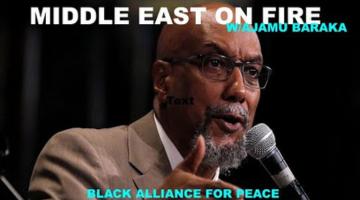 Ajamu Baraka, Black Agenda Report Editor and Columnist, joins Garland Nixon to discuss Israel's aggression in West Asia and the ongoing genocide in Palestine.
 In this week’s segment, we hear about how a tornado impacted the Black community of St. Louis, which already suffered as a result of decades of destructive public policy. But first, we discuss…


