by Wangui Kimari
There’s lots of talk about the cultural ties that bind Brazil, the economic dynamo, to Africa, ancestral home to half Brazil’s population and current source of much of its imports. However, “if this was a relationship premised on deep ‘cultural affinity’ as is often stated, Afrikan states would ask Brazil why Afro-Brazilians are consistently being killed by genocidal police/militarized forces.”
Brazil-Afrikan State Collaborations and the Tokenization of “Cultural Affinity”
by Wangui Kimari
“Ninety percent of the Brazilian imports from Afrika are oil and other natural resources.”
Much has been said about the vast increase in Brazil and Afrikan state collaborations, but perhaps not enough. Often these relationships, in many of their current iterations, are posited as South to South alliances that navigate away from the traditional/colonial exchanges of North/South (a geography depending on which genocidaire drew the map) that are the norm in so called international relations. These “norms” are emblematic of a “native” and “emperor” interaction as the latter, although with no legitimate clothes, has a plethora of violences that are ready to be dispensed at whim. For recent demonstrations of this violence see Mali, Haiti, Congo, Central African Republic, Somalia, Pakistan, Libya and an endless list of tyranny, betrayals and litanies for survival.
These Northern emperors (again with no real clothes) are now apparently somewhat appalled that they are no longer the main source of inspiration and sites of convergence for these two partners, Brazil and Afrika, who with “cultural affinity,” supposedly, stride forth with each other towards novel destinies, ostensibly, free of China and Europe.
While I recognize the possibilities inherent in these South-South exchanges, and the sometimes courage in the face of, for example, AIDS, it is undeniable that the current state sanctioned political and economic partnerships energized, supposedly, by “cultural affinity,” are in essence a tokenization of the Afrikan presence and struggle which originate on the continent, and that are central to the existence of what is now Brazil. These declarations of similarity are inane, especially in light of the fact that 90% of the Brazilian imports from Afrika are oil and other natural resources. Furthermore, the increase to 37 (from 17) Brazilian embassies on the continent in the last decade – political stations that are filled, principally, with white or white-passing bodies, rarely Afrikan – does not do much to support this much heralded kinship.
“These declarations of similarity are inane.”
If this was really a partnership of fellows it would entail a much more powerful and incisive interrogation of Afrikan survival (and not just Afrikan “survivals”) in both of these locations. And if such an intentional process were to be the basis of any interaction, Brazil would ask Afrikan states why their citizens are dying from the same afflictions, capitalism provoked and exacerbated, 500 + years since many of them were taken away. In addition, there would be questions about why Afrikan bodies in Brazil and in other parts of the diaspora are not often remembered and valorized in ceremonies and curricula on the continent. Above all, we would on the continent need to respond to questions about why we have not striven to collectively create a consistent consciousness directed towards remembering, responsibility and action to remedy the fissures and pains that result(ed) from these intended separations.
If it was so, if this cultural affinity was really taken seriously, Afrikans on the continent would also ceaselessly remember Haiti and its (endless) revolution and know that Haiti, Jamaica, Brazil, Trinidad, Martinique, Guyana, Grenada and wherever else Afrika has been forced to relocate, are us.
In turn, if this was a relationship premised on deep “cultural affinity” as is often stated, Afrikan states would ask Brazil why Afro-Brazilians are consistently being killed by genocidal police/militarized forces (see some info on this here and here ). We would also question what pride of Blackness is at all conveyed in the white supremacist soap operas that Brazil exports to our continent; TV programs where Black is rarely seen unless it is in the plantation, kitchen or the sexual (ized) encounter. Furthermore, we would agitate and inquire about why Afrikans in Brazil are still the poorest, the first killed by police, and require affirmative action policies to go to university in this “racial democracy” that is now singing about its “cultural affinity” with the continent.
In addition, the often horrific treatment of continental born Afrikans who live in Brazil (see some info here and also “Retaking the Middle Passage: Glimpses of a Modern African Diaspora in Brazil”) challenges these declarations of kinship. In contrast, this behaviour shows that for all of this talk of cultural proximity the real motivation of these alliances is a capital which perpetuates already established colonial relationships in the landscape, and therefore necessitates a tokenized celebration of Afrikan culture(s). This is indisputable for, after the final transactions, where does the money from these Brazil and Afrikan state ventures go if not into European/American banks?
“We would agitate and inquire about why Afrikans in Brazil are still the poorest, the first killed by police.”
Rather, these present political and economic meanderings (re) organized by Afrikan states and Brazil propel us further into the machinations that jeopardize Afrikan existence. Look at the violences brought about by Brazilian mining companies in Mozambique (also see here), and study the images that are channelled from Brazil to Afrika and you will recognize immediately that the powerful and potential longstanding links that are enduring are disregarded in the interest of coal, diamonds and oil; all of which belie the importance of this celebrated “cultural affinity.”
As is evident, these heralded alliances do not, in any significant way, differ from the capital of Europe/America. Rather, they are a tokenization of what could – if it were people to people – be a real powerful link; one that is demanded, not only from the powerful Black echoes from the bottom of sea and all around us, but are exigencies that are required for all of our Afrikan liberations and the healing, survival and resistances intrinsic to these freedoms.
At present, it is hard to see whether these political and economic alliances pursued and energized by a “cultural advantage” are anything different from the violent status quo that is many of our Afrikan lives. While even sometimes posited as Brazil paying its “debt” back to Africa, we must not be convinced that these recent Brazil and Afrikan state exchanges are fully interested in the implications of what Afrikan solidarity requires. Therefore in the name of “cultural affinity” that goes beyond these state sanctioned veneers, we must challenge these tokenizations and seek each other, people–people, through different relationships that actually do prioritize our survival.
Wangui Kimari is a native of Kenya living in Toronto, Canada. She is an organizer with the Bunge la Mwananchi/ the Peoples Parliament, in Kenya and with the Network for Pan-Afrikan Solidarity, in Canada. She can be contacted at wanguiwathuo@yahoo.com.

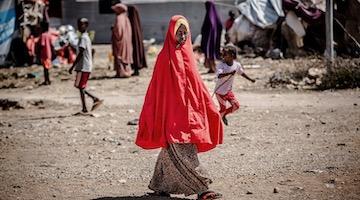 Somalia’s current corruptionist comprador bourgeoisie has no independent socio-political base and is therefore totally beholden to Western imperialist interests.
 What is it about Chávez and the national-popular movement bearing his name that is so threatening to the US Empire to this day?
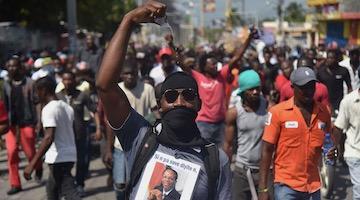 The West’s treatment of Haiti confirms that white supremacy has still not abandoned its plan to impose a racially racist, violent, capitalist and imperial world order.
 Community Control is Best Route to Abolishing Policing As We Know It
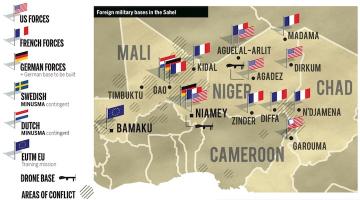 To justify US and European military occupation of much of Africa, migrants seeking jobs in the north of the continent or in Europe “are labeled as criminals and terrorists” when they are “just look


