by BAR managing editor Bruce A. Dixon
The same greedy corporations that have long funded white politicians now finance what used to be traditional civil rights organizations like SCLC and an entire new class of black politicians. The cutting loose of black political leaders from their constituencies has dire consequences for the entire American polity.
Bankrupt Black Leadership, Nukes and Environmental Racism
by BAR managing editor Bruce A. Dixon
For more than a generation, in the last third of the twentieth century, black America was the immovable rock that anchored the left side American political life. Places like Detroit, New Orleans and St. Louis were literally and figuratively where the left lived.
It was a time when civil rights organizations and African American politicians could reasonably be expected to object, to protest, to publicly resist blatant crimes against their constituents on the part of governments and corporations. But by the turn of the 21st century, corporations had begun to finance the rise of a new class of elite black political leaders, politicians like Atlanta's Kasim Reed and Shirley Franklin, Philadelphia's Michael Nutter, and Newark's Corey Booker, and of course President Barack Obama. At the same time, those corporations became the major funders of what used to be called civil rights organizations like the Urban League, the NAACP and the Southern Christian Leadership Council.
Except for ceremonial bows and obeisances like Black History Month and pleas to vote for them on election day, Black America's political leaders are now free from most obligations to black people, and what used to be vigilant, vocal civil rights organizations are silent in the face of corporate crimes like environmental racism against black communities, let alone the wider implications of these crimes for all Americans.
One of the best examples of this is in Georgia, where the Obama administration in 2009 granted Southern Companies $800 million to underwrite the construction of two nuclear reactors next to a pair of leaky existing nukes in a poor, mostly black Georgia town where almost every family has a cancer case or two. But who would raise the cry? The Southern Christian Leadership Council, perhaps, based in nearby Atlanta? No way. The CEO of Southern Companies headed up SCLC's building fund, raising millions to pay for its Auburn St. headquarters. So SCLC is silent.
Although poor rural black people are the first to pay the price of this atrocity, they won't be the only ones. Georgia's Public Service Commission, which is supposed to look out for consumers has allowed the power company to add $10 to $20 per month to hundreds of thousands, perhaps millions of utility bills to underwrite construction costs of this deadly monstrosity. Even officials of the Nuclear Regulatory Commission have noted that the reactor design is similar to those of the ill-fated Fukushima reactors in Japan, and ought to be re-evaluated in the light of that disaster.
This is a textbook example of how the cutting loose of the black political class from black people has affected the entire American polity. The radioactive poisoning of poor black communities alone should have roused SCLC and the black political class to action defending its supposed constituency. If the Bush-Cheney gang had done such a thing , cries of “environmental racism” would ring across the country. But corporate-funded black leaders, who should be the canaries in the coal mine, don't allow themselves to criticize the corporate-funded black president. So the silence of the black political class enables the theft of hundreds of millions, perhaps billions from ratepayers statewide and permit the construction of the first of a new and hazardous generation nuclear plants that threaten the safety of millions.
For Black Agenda Radio, I'm Bruce Dixon. Find us on the web at www.blackagendareport.com.

 The idea that a reverse migration to the south is a route to greater political power should be treated with skepticism.
 Richard and Roberto would like to dedicate this feature to Glen Ford, one of the fiercest critics of U.S. corporate media the country has ever known.
 There will not be true democracy for Africans as long the U.S., EU, NATO, and Israel train and finance the military in these nations.
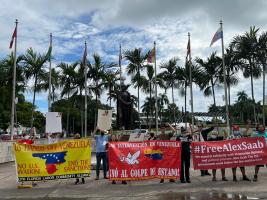 The U.S. has twice kidnapped Venezuelan diplomat Alex Saab.
 Conspiracy laws, RICO statutes and "gang" designations are tools of police and prosecutorial misconduct and the maintenance of the mass incarceration state.


