by BAR executive editor Glen Ford
Americans have for so long pretended that Arab nationalism is dead, their corporate media fail to recognize an Arab nationalist rebellion when it breaks out in front of their noses. Arab nationalism is more dangerous than Islamist politics to U.S. imperial hegemony, because “the path to mass mobilization can be direct and democratic, as evidenced by the spread of the Pan-Arab conflagration from the spark in Tunisia only weeks ago.”
The Arab Nationalist Reawakening in Egypt and Beyond
by BAR executive editor Glen Ford
“Washington cannot tolerate a popular nationalist regime in power in Egypt.”
Both the United States and Hosni Mubarak’s regime seek “stability” for Egypt – by which they mean continuity of grotesque social and economic inequalities, institutionalized thievery and perpetual subservience to U.S. imperialism and Israeli terror. The current “revolution” – the people’s own word for what is occurring – seeks to destabilize the oppressive and humiliating status quo, and thereby make human dignity and hope possible.
To preserve the stability of his comprador regime, which has made itself indispensable to U.S. imperial strategies in the region, Mubarak threatens to plunge Egypt into chaos – to make the society scream. His huge police force, a portion of which appeared to have disintegrated in last week’s test of wills with the people, now roams Cairo, spreading mayhem in order to justify the return of the police state, while a mobilized people attempt to preserve neighborhood order and safety against Mubarak’s roving bands.
If the world is turned upside down, there must be a revolution going on. But, what kind?
The Tunisian, Egyptian, Jordanian, and other risings are a reawakening of Arab nationalism, the viral force that dictatorships like Mubarak’s are paid billions yearly to suppress. Like all nationalisms, the Arab variety demands that there be a collective response to the hurts and insults committed against the Arab Nation, and the attainment of a justice that is worthy of the people. Arab nationalism is anathema to U.S. imperialism, and cannot long coexist with an aggressive, racist and expansionist Zionism whose very presence in the region represents humiliation and defeat and an absence of justice.
“Mubarak threatens to plunge Egypt into chaos – to make the society scream.”
Arab nationalism is more dangerous to imperial hegemony than Islamist politics – which is why the Americans and Israelis encouraged the rise of Islamism as a counterweight to Arab nationalism and secular left movements. Arab nationalism requires no imams or other intermediaries or experts to justify collective action in service of the people. The path to mass mobilization can be direct and democratic, as evidenced by the spread of the Pan-Arab conflagration from the spark in Tunisia only weeks ago.
The Arab nationalist rebellion is centered on American-backed regimes in Egypt, Tunisia and Jordan because U.S. imperialism is the main impediment to the Arab people’s national aspirations in their respective countries and the world. The “strongman” works for the Americans, not the Arabs – and therefore, indirectly, the Israelis. Although the Left has been repeatedly crushed in the Arab world over the decades, Arab nationalism is embedded in the various countries’ identities and cannot be permanently suppressed.
That’s why Washington cannot tolerate a popular nationalist regime in power in Egypt, the largest Arab country and irreplaceable imperial and Zionist ally. If Egypt escapes the control of a comprador, imperial-subservient, anti-nationalist regime, the whole American position in the region unravels. Washington is desperate that some form of gangster order prevail, even if that means a “Tiananmen” Square”-like solution.
“Arab nationalism is embedded in the various countries’ identities and cannot be permanently suppressed.”
As this is written, Mubarak’s shadowy non-uniformed forces have been unleashed on the protestors in Cairo’s Tahrir Square. It is widely understood that the Egyptian military is key to the immediate situation. But, which military? The army of Mubarak’s politician-businessman generals, who have become integral cogs in the American imperial machine, the main recipients of U.S. “aid,” who have seized executive positions in profitable military enterprises and created a community outside of general Egyptian society, much like the gated communities of the newly-rich? Or the mass army of half a million men, drawn from a population where 40 percent of the people subsist on less than $2 a day, an army whose relatives and friends are gathered in Tahrir Square and other centers of resistance in Alexandria, Suez and upper Egypt? Or, the army of junior officers whose Arab nationalism recoils at the regime’s alliance with their people’s enemies?
Had Mubarak’s generals not feared crossing the Arab nationalist patriotism of their own soldiers and junior officers, the popular rebellion would have been crushed by tanks before now.
If the people’s revolution were to be joined by a popular people’s army, Egypt would rock the Arab world and beyond, and bring about a much swifter demise of U.S. imperialism, the pan-Earth enemy.
BAR executive editor Glen Ford can be contacted at Glen.Ford@BlackAgendaReport.com.

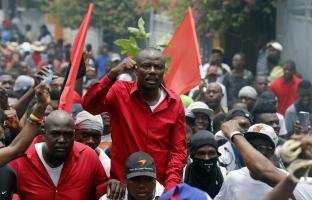 Dahoud Andre is a member of KOMOKODA, the Community to Mobilize Against Dictatorship in Haiti, and host of Eritye Papa Desalin, the Heirs of Jean Jacques Dessalines, a daily Haitian community radio…
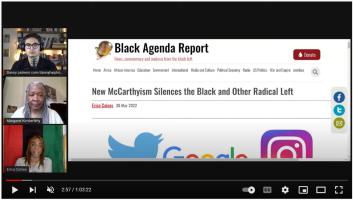 Erica Caines, Editor of Hood Communist and Coordinating Committee Member for the Black Alliance for Peace, joins the stream to discuss the New McCarthyism and its implications.
 It is disheartening to hear movement leaders say they are inspired by Martin Luther King while also supporting the U.S. proxy war against Russia. Like all wars it endangers the lives of…
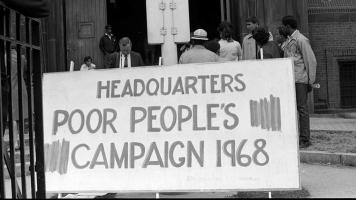 The demands for justice at home and abroad must not be sacrificed on the altar of what is called pragmatism. The false choices presented by liberalism can undermine the movement altogether.
 A May Day 1928 essay by Black communist Williana “Liana” Jones Burroughs – aka Mary Adams – recounts the history of African revolt in the Americas.


