by Meena Jagannath and Fran Quigley
Although the reviled United Nations occupation force remains the main muscle in Haiti, the farcically elected president, Michel Martelly, is a dictator-in-waiting. “Sweet Micky,” as he is known, is a fan of Papa and Baby “Doc” Duvalier, the father and son despots who slaughtered tens of thousands. “Martelly argued that Duvalier should receive amnesty for decades of human rights violations, including arresting, torturing, and killing political opponents in a notorious three-prison ‘Triangle of Death.’”
“This is How Duvalier Started”: Critics of Haitian President Imprisoned
by Meena Jagannath and Fran Quigley
“Martelly has openly embraced the return to Haiti of former dictator Jean-Claude Duvalier.”
PORT-AU-PRINCE, HAITI. An unrelenting sun beats down on the streets of downtown Port-au-Prince, and sweat pours off the three dozen men and handful of women who sing, dance, and wave home-made signs as they block the entrance to the government Ministry of Social Affairs.
This is the latest in a series of weekly demonstrations by the grassroots organization MOLEGHAF, (Movement for Liberty and Equality by Haitians for Fraternity), calling for the government to create jobs and increase social support in this country with 80% unemployment and widespread poverty. Some of the signs read, MOLEGHAF Di Fók Nou Travay: MOLEGHAF Says We Must Have Work. Most of the protest songs are directed to Haiti’s President, Michel Martelly: “Martelly has left us behind!” a young man shouts through a megaphone.
A police truck filled with five rifle-toting members of the Haitian National Police tries to pass directly through the group. The protesters stop and surround the truck, banging pots and pans within inches of the pointed rifles. It is a tense moment, all the more so because MOLEGHAF members know well the risk they are taking.
“Most of the protest songs are directed to Haiti’s President, Michel Martelly.”
It was at a similar demonstration a few weeks ago when police arrested two of the group’s leaders, longtime activists David Oxygène and Dukens Charles. Days later, four more MOLEGHAF members were arrested in their home. Oxygène was charged with breaking the window of a car belonging to the director of CONATEL (National Coordination of Telecommunications), while Dukens asked the police to arrest him to be in solidarity with his fellow activist. The activists say the charges are completely unfounded, but Oxygène and Charles remain incarcerated in the National Penitentiary. The other four MOLEGHAF members who were arrested have been released, but Oxygéne was recently transferred to a section of the prison called "Titanic 5-6," notorious for its hard-core inmate population and deplorable conditions, including extreme overcrowding and lack of beds and toilet facilities.
Attempts to reach the Government of Haiti for comment on the arrests were unsuccessful. Despite repeated requests, no police report or evidence of the allegedly vandalized car has been presented to the investigating judge.
“Oxygéne was recently transferred to a section of the prison called ‘Titanic 5-6.’"
Haiti has an inglorious history of its country’s leaders imprisoning their political opponents, but people here hoped that era was gone for good. Martelly’s predecessor, René Preval, was widely criticized for his administration’s response to the January 12, 2010 earthquake, but Preval was also credited with ending politically-motivated violence and arrests. Martelly, who took office in 2011 with significant U.S. government support after an election marred by the disqualification of the country’s majority party, had not cracked down on his opponents either.
But there have been signs that Martelly was intolerant of dissent and eager to consolidate power. Journalists have complained after Martelly threatened to use force against those who spoke ill of the country, including the press, and members of his staff roughed up some journalists and destroyed some of their equipment. Martelly has also refused to hold elections to replace Haitian senators whose terms have expired.
Perhaps most concerning for Haitians looking to put their country’s legacy of political repression behind them, Martelly has openly embraced the return to Haiti of former dictator Jean-Claude Duvalier. Martelly recruited Duvalier’s son and former Duvalier officials to join his administration, and Martelly argued that Duvalier should receive amnesty for decades of human rights violations, including arresting, torturing, and killing political opponents in a notorious three-prison “Triangle of Death.”
“Journalists have complained after Martelly threatened to use force against those who spoke ill of the country, including the press.”
The historical comparison is not lost on David Oxygène’s attorney, Haitian human rights lawyer Mario Joseph of the Bureau des Avocats Internationaux, who also represents several Duvalier victims pushing for prosecution of the former president. “Oxygène is simply a political prisoner,” says Joseph. “This is how Duvalier started, too.”
Back at the demonstration, the MOLEGHAF members slowly allow the police truck to pass. For today, the rifles remain quiet, and no arrests are made. But the activists say they will not be silenced. Now, some of their signs include calls for freedom for Oxygène and Charles. The oldest demonstrator is Dieuseul St. Cyr. “What am I doing here, a 58 year-old man standing in the road?” he asks. “But I have not had work since 2008, and Martelly needs to be aware of the problems of the poor.”
The demonstrators prepare to put away their signs and noise-makers for the day, but close with one last song in Creole. “Martelly, we are asking for work, we are asking for food, but you give us prison,” they sing.
Meena Jagannath is a legal fellow at the Bureau des Avocats Internationaux and Fran Quigley is a clinical professor at Indiana University Robert H. McKinney School of Law.

 BAR Executive Editor and Senior Columnist Margaret Kimberley advises caution regarding the narrative that the US is in a state of decline. The US is committed to achieving full-spectrum dominance…
 In this week’s segment, we discuss events in the Horn of Africa as the Somaliland region requests U.S. recognition and the Trump administration ends some sanctions against Eritrea. But we begin by…
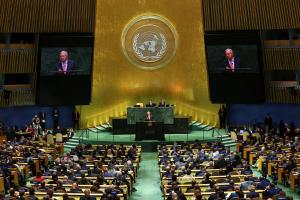 Ajamu Baraka discusses U.S. influence over the United Nations and its Security Council as the 81st General Assembly high-level meetings take place.
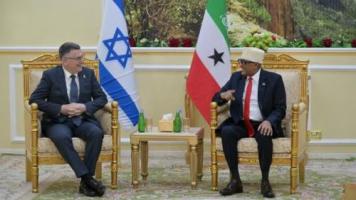 Abayomi Azikiwe, editor of the Pan-African Newswire, discusses Israeli recognition of the Somaliland region, the US reduction of sanctions on Eritrea, a new anti-government alliance in Ethiopia, and…
 The trope of the United States being in a state of decline is a common one, but it should not be accepted without scrutiny. The U.S. faces crises but remains dangerous, powerful, and single-minded in…


