Behind much opposition violence stood US regime-change NGOs.
“Nicaragua’s social and economic achievements and its open rejection of imperialism present the classic ‘threat of a good example.’”
Live from Nicaragua: Uprising or Coup? A Readeris a thoughtful, multifaceted collection of essays, eyewitness accounts, interviews and news clips of last year’s US-backed regime-change war against Nicaragua. Precisely because of its importance, quality and scope, this 270-page e-book will neither be acknowledged nor reviewed in the corporate media. The book is offered free by Alliance for Global Justice (afgj.org) as an ebook and aPDF.
In April of 2018 armed and unarmed US proxies in collaboration with Nicaraguan elites launched a war on the democratically elected Nicaraguan government. The war disrupted transportation and communications and sabotaged the economy, with vandalism, arson, assault, beatings, killings, torture and rape. Hundreds of violently enforced roadblocks were built throughout the country. Opposition forces targeted civilians, government workers, public buildings, homes, roads and commerce.
The war began in April, 2018, with pretextual protests against proposed changes to the government pension system presented in opposition media as an austerity measure. In fact, the proposal was a rebuff to the austerity plan sought by business elites and the International Monetary Fund. Protestors next complained that police had killed protestors during the first protests, but those killings had been falsely attributed to police or were entirely imaginary. Demonstrations continued, with armed, violent “protestors” executing criminal operations under the cover of protest.
The war (aka “regime-change operation” or “coup attempt”) ended three months later in July with the removal of opposition roadblocks. Over 250 people had been killed and many more injured. More than 250 buildings were burned down or ransacked; public sector property losses were over $230 million USD. GDP fell nearly 4%, a loss to the economy of nearly 1.5 billion USD, with job losses of up to 300,000.
“Over 250 people had been killed and many more injured.”
Live from Nicaragua: Uprising or Coup? A Reader refutes cherry-picked and erroneous accounts uniformly adopted by predominant media sources in their misleading narrative of the war, its causes and its politics. Their tale imagined a peaceful, domestic, progressive protest movement crushed by the brutal national police of a dictatorial regime, thus reversing victim and aggressor, right and left, sovereignty and subjugation. The tale was ubiquitous: New York Times, Guardian, New Yorker, British Broadcasting Corporation (BBC), Huffington Post. “Left” and alternative sources repeated the story: North American Congress on Latin America, Democratic Socialists of America, Jacobin Magazine, The Nation, The Guardian, Democracy Now! So did Washington-aligned human rights groups like Amnesty International, Human Rights Watch, and the Inter-American Commission on Human Rights.
And behind much opposition violence stood US regime-change NGOs: National Endowment for Democracy, United States Agency for International Development, International Republican Institute, AFL-CIO. Nicaragua-based NGOs, some funded and created by the US, also participated, along with Nicaragua’s Catholic Church hierarchy, which helped plan and execute some of the worst violence.
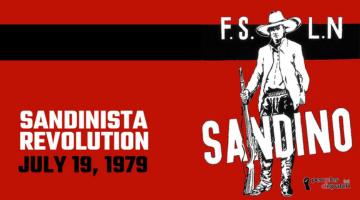
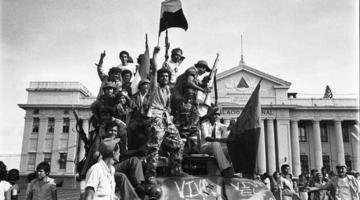
The book’s contributors include John Perry on the media, Max Blumenthal and Chuck Kaufman on US funding of regime-change operations, andEnrique Hendrix on war deaths and their misreporting.In entries by Gabriela Luna, Kaufman, Brian Willson, Nils McCune and Dan Kovalik, the long arc of the Sandinista Revolution and its accomplishments emerge, from the triumph in ’79, the reversal in 1990, and the return to power in 2007. With the Revolution came extraordinary, rapid advances in health, education and literacy, and while 1990 brought neoliberal administrations that reversed many gains, the second era of Sandinista government (2007 to the present) brought a return of social progress and economic success. Since 2007 the number of the undernourished was cut in half, free health care and education was guaranteed to rural communities, maternal and infant mortality rates plummeted, rural access to electricity jumped from 54% to 96%, and Nicaragua became fifth in world rankings of gender equity.
“The second era of Sandinista government (2007 to the present) brought a return of social progress and economic success.”
Many of these material gains are due to Nicaragua’s “popular economy” emphasizing the smaller domestic, informal sectors, which provide much of Nicaragua’s food, clothing and housing. Jorge Capelán’s expert analysis of the Nicaraguan economy traces its development over the last forty years throughout the first and second periods of Sandinismo and during the interim neoliberal period. Capelán explains how Nicaragua maintained stability and met people’s needs during and after the 2018 war, not least because of strategic government policy and regional alliances with Venezuela and Cuba (e.g., Bolivarian Alliance for the Peoples of Our America - Peoples' Trade Treaty [ALBA] and PetroCaribe). All this, explain Kevin Zeese and Nils McCune, made Nicaragua the target of the US empire’s “upside-down class war.” Nicaragua’s social and economic achievements and its open rejection of imperialism present the classic “threat of a good example” to all poor, subjugated countries, while its good relations with Cuba, Venezuela, China and Russia provokeparticular imperial animosity.
But the “democracy” rhetoric of the US-backed opposition begs explanation. Kathy Hoyt writes that for some, including those trained by NGOs funded by the US and EU, “material improvements are not enough for them or they are not particularly interested in them.” Instead they complain of the political system, theparties, elections, President Ortega personally, etc. But for supporters of the government, the remarkable improvement in the lives of the poor do matter. Hoyt quotes the words of Orlando Nuñez Soto who, thinking of Cuba, said, “we are seduced by the fact that the children eat and go to school.”
The recent unanimouspassage of the NICA Act by the US Congress and Senate announces that the war againstNicaragua is not over. This unlawful siege-by-sanctions immiserates the lives of the poor and vulnerable, just like the illegal sanctions the US inflicts on dozens of countries. This book should arm the solidarity movement to resist the cruel methods and reactionary aims of the US empire.
Roger Stoll is a Latin America/Caribbean solidarity activist with the Task Force on the Americas, a three-decades-old anti-imperialist human rights organization. He has published articles, book reviews and political poetry in Dissident Voice, Counterpunch, Popular Resistance, San Francisco Examiner, ZNet, Jewschool, and New Verse News.
COMMENTS?
Please join the conversation on Black Agenda Report's Facebook page at http://facebook.com/blackagendareport
Or, you can comment by emailing us at comments@blackagendareport.com


 “In other words, people revolted against the system. But they did not know that the system was called capitalism.”
 The climate crisis is first and foremost a crisis caused by the U.S. denying other nations their sovereignty through imperialist violence, but the U.S. climate movement is more comfortable talking…
 "Slimy green cesspool reflecting capitalist rule" is the latest from BAR's Poet-in-Residence.
 The engraved revolvers Erdogan handed out in Ankara showed that NATO has stopped pretending to be a defensive alliance and embraced its new role as the West's premier weapons trade fair.
 Cuba's president, Miguel Diaz-Canel Bermudez, posted this statement in response to the State Department report on his X/Twitter account.


