by Dale McKinley
Not only did the ANC consciously choose (before 1994) to turn its ideological and strategic back on the possibilities of organizing a massive wellspring of popular power to pursue much more thoroughgoing systemic change, but it also made a conscious choice after 1994 to exercise its unparalleled political position and power (mostly through the state) in partnership with and in service to capital.
Book Extract: South Africa’s Corporatized Liberation: A Critical Analysis of the ANC in Power
by Dale McKinley
This article previously appeared in Pambazuka News.
“The ANC itself and the state it has politically controlled for the last twenty-odd years have become corporatized in both form and content.”
The ANC has become the key political vehicle, both in party and state form, of corporate capital; both domestic and international, both black and white, both local and national, and constitutive of a range of different ‘fractions’ of capital.
Over the last twenty-odd years it has been the fight on and over this terrain – with some for, some against, some in the middle – that has principally defined the journey of the ANC since 1994. Central elements of this have taken place within the ANC and its alliance partners but also between the ANC alliance and the majority of workers and the poor, along with allies, both individually and organizationally.
Like the journey of capital itself over the last few centuries, this fight has produced different “fractions” or, more accurately in political terms, factions within the ANC. Examples would be a modernizing, cosmopolitan and technocratic faction; an older-style, traditionalist nationalist faction; and a politicized gangster faction. There are some inter linkages and each occupies various “positions” as well as exercises differing degrees of power in the party set-up at national, provincial and local levels.
At the heart of the ANC’s strategy and tactics is an underestimation of the revolutionary potential and liberatory ethos of popular, democratic power and how it can be harnessed and exercised to lay down the institutional, policy and mobilizational foundations for systemic change. Underlining this is the patently false notion that capital’s ownership and control of the economy (most often presented as the main element in a “balance of forces” unfavorable to more radical change) has meant, a priori, that the power of capital is objectively unassailable and therefore that more radical, systemic change is practically impossible.
“The ANC made a conscious choice after 1994 to exercise its unparalleled political position and power (mostly through the state) in partnership with and in service to capital.”
Not only did the ANC consciously choose (before 1994) to turn its ideological and strategic back on the possibilities of organizing a massive wellspring of popular power to pursue much more thoroughgoing systemic change, but it also made a conscious choice after 1994 to exercise its unparalleled political position and power (mostly through the state) in partnership with and in service to capital – in all its various forms and at all levels of society.
As a result, the ANC itself and the state it has politically controlled for the last twenty-odd years have become corporatized in both form and content, producing a major shift in the balance of forces away from the mass of workers and the poor. This is in direct contradiction to the argument that the ANC’s choices have been made because of the existing “balance of forces” and in order to create the spaces to radically change that balance in favor of the masses and away from the dominance of capital.
The ANC’s corporatized state is constitutive of a triangle of power: class, organizational and institutional. This does not mean that corporate capital controls the state; it simply means that the ANC has corporatized its politics and organizational form in a way which is reflected in the three components of state power and how that power is exercised and deployed. Where elements of the state, both individual and institutional, do not fully follow or bend to the dictates of this centralized power triangle, they are variously attacked, marginalized, restructured or eliminated.
Extended to a society-wide level and under the overall theoretical and conceptual frame of the ANC’s National Democratic Revolution (NDR), the driver of societal development has been the party–state–capital nexus. In this scenario, the party becomes the ultimate political vanguard of the various capitalist class interests that run it, and of capital itself, with the state as the main vehicle for ‘implementation’ and with the Black Economic Empowerment (BEE) program as the main driver.
What is different here from the generic corporatized model is that the necessity of private profit is replaced by the necessity of maintaining control of institutional power, through the state, as the means for both access (to the varied forms of private and public capital) and personal or class incorporation (lifestyle, patronage, upward mobility).
“The needs and interests of the majority of people are secondary.”
In order to cover politically for this, the ANC presents itself as the self-declared sole “representative” and “custodian” of the “will of the people,” of the “nation” and, indeed, of the entire struggle for liberation. Here, the needs and interests of the majority of people are secondary (as is the case with the general thrust of the corporate model), although politically they remain central to the ongoing project of the ANC’s efforts of regeneration and re-legitimization or consent (with the electoral terrain being crucial).
Another way of looking at this is at a more internal, organizational level. Just as with corporate CEOs and their executive structures, it is at the level of leadership structures in the party that power lies in the ANC. This starts with the president and the National Executive Committee (NEC) and filters down to provincial, district and branch levels. Like the corporate set-up, ANC leaders (and here President Zuma is the prime contemporary example) know that they only need to have the support of a majority at the level of the various leaderships as well as from the main ‘stakeholders’.
What this ensures is that power is not about or in service to the people (in the case of corporates, the consumer/customer) but it becomes the “property” of the leadership in the key party structures. As a result, the leaders can effectively ignore or buy off, intimidate or marginalize party members and the larger populace, except at election time when the dominant approach shifts to one that is largely about political salesmanship, commodification and party loyalty.
“The leaders can effectively ignore or buy off, intimidate or marginalize party members and the larger populace, except at election time.”
What the ANC has been trying to do ever since it came to power, and even more intensely over the last few years as the realities of the choices it has made have begun to bite deeper and harder, is convince itself, its alliance partners and its main constituencies that it is the only entity able to lead South Africa politically. [Further] that the path it has chosen (with a few twists and turns here and there, although these are mostly about who drives the ANC vehicle) is not only in the interests of the majority of people but is, objectively, the only possible path to pursue.
Those, whether singularly or collectively, who would question, dissent from or oppose any of this are labeled naïve, “too smart” or useful stooges for third forces of various kinds (usually identified as white, foreign, intellectuals, etc.). Or else they are dedicated political enemies, whether from the left or the right, of the ANC, the “liberation movement” and, indeed, the “revolution” itself.
This approach translates into increased powers and resources for the intelligence-security cluster in the state. Depending on the perceived “threat level,” the ANC and the state respond through a concerted campaign of denial, delegitimization or the use of coercive force and violence.
To paraphrase a term used by Horace Campbell to describe post-independence Zimbabwe -- ‘the privatization of liberation’ -- what has happened in South Africa is the corporatization of liberation.
In the twenty-odd years since the ANC has been in power, this has allowed for the generalized political and economic commodification of South African society and its development, with all the attendant impacts on governance, the exercise of power, the understanding and practice of democracy, and, on a larger tableau, societal-wide political, economic and social relations.
* Dale Mckinley is an independent writer, researcher and lecturer based in Johannesburg. He holds a PhD in Political Economy/African Studies. His new book, ‘South Africa’s Corporatised Liberation: A critical analysis of the ANC in power’, is published by Jacana Media (2017).

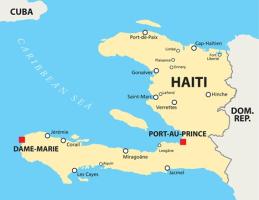 As the white rulers of Haiti push for illegitimate elections, can the “Montana Accord”- an agreement among some civil society groups to return democracy to Haiti - offer a way out of the country’s…
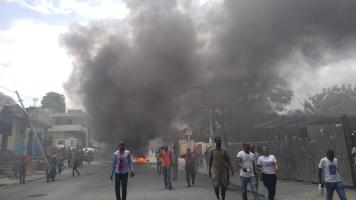 March 29, 2022 - Haitian community activists are out in the streets to commemorate the 35th anniversary of the Haitian constitution, drafted after the fall of the Duvalier dictatorship, and to…
 March 31 has been designated as the deadline for Wayne County residents to pay back property taxes from 2019 and before despite the failure to provide adequate assistance to working and impoverished…
 Colombian Vice Presidential candidate Francia Marquez is again threatened by right wing groups in that country. She demands that president Ivan Duque protect her and others leaders as well.
 Leaked stories from the Pentagon have exposed how mainstream media reports Russia’s conduct in the Ukraine war, in a bid to counter propaganda intended to get NATO into the conflict.


