Massacre in Cleveland: Lynch Law Was Never Repealed
A Black Agenda Radio commentary by Glen Ford
America’s “unwritten law” dictates that nothing unusual is happening when 13 cops shoot 137 bullets at an apparently unarmed Black couple in Cleveland, a Black-run city. Ida B. Wells, who fought and chronicled lynching at the turn of the 20th century, would feel horribly at home.
Lynch Law Was Never Repealed
A Black Agenda Radio commentary by Glen Ford
“The extrajudicial killing of African Americans, a practice that is not considered a crime, based on America's ‘unwritten law.’”
In the year 1900, the great Black activist and journalist Ida B. Wells wrote an article called “Lynch Law in America.” It began with these words:
“Our country's national crime is lynching. It is not the creature of an hour, the sudden outburst of uncontrolled fury, or the unspeakable brutality of an insane mob. It represents the cool, calculating deliberation of intelligent people who openly avow that there is an 'unwritten law' that justifies them in putting human beings to death without complaint under oath, without trial by jury, without opportunity to make defense, and without right of appeal.”
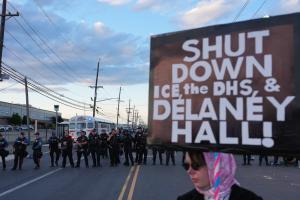
In Cleveland, this week, 13 police officers, 12 whites and one Hispanic, fired 137 bullets at a Black man and woman after a high-speed car chase. No weapon was found on their bullet-riddled bodies. Community members charged the victims were lynched.
Less than two weeks before, in Jacksonville, Florida, a white man who didn’t like Black teenagers playing loud music at a gas station fired eight or nine shots at 17-year-old, unarmed, Jordan Davis, killing him. The middle-aged shooter claimed he was justified by Florida’s “stand your ground” law that allows white people to act out their fears, hatreds, or mood swings with impunity – the same claim made by another Florida gunman when he executed 17 year-old Trayvon Martin without trial or “right of appeal.”
Young Trayvon drew his last breath in time to be listed among the 120 Black people known to have been extra-judicially executed in the first six months of this year – one killing every 36 hours. The report, compiled by a handful of people for the Malcolm X Grassroots Movement, had to be pieced together from news clippings and other sources. That’s because there is no data base on the extrajudicial killing of African Americans, a practice that is not considered a crime, based on America's “unwritten law.” In fact, it’s treated even more casually than a sport – at least in sports they keep statistics.
“The Malcolm X Grassroots Movement had hoped to follow in Ida B. Wells’ footsteps with their report.”
Ida B. Wells kept statistics. She and a few colleagues tallied 3,436 lynchings of Blacks in the 33 years between 1889 and 1922. Eighty-three of the victims were women. Lynching reached its high-water mark in 1892, when 160 African Americans were slaughtered because of their race. That number will be far exceeded this year, at the rate the blood is flowing. The Malcolm X Grassroots Movement had hoped to follow in Ida B. Wells’ footsteps with their report; they reasoned that, armed with the facts, Black folks would get fired up enough to launch a modern day movement against lynching – just as Ms. Wells work propelled lynching to the center of the movement of her day. But the 2012 report failed to reach many people, because it was largely ignored – not just by the corporate media, but by much of so-called progressive media outlets and “traditional” Black leadership. That’s because, in the early 21st century, only certain types and classes of Black folks are likely to be extra-judicially put to death, or consigned to the social death of America’s Black Prison Gulag: poor people, like Malissa Williams and Timothy Russell, snuffed out like vermin in the Black-run City of Cleveland. For them, lynching remains the “national crime” and the “unwritten law.”
For Black Agenda Radio, I’m Glen Ford. On the web, go to BlackAgendaReport.com.
BAR executive editor Glen Ford can be contacted at Glen.Ford@BlackAgendaReport.com.
You are missing some Flash content that should appear here! Perhaps your browser cannot display it, or maybe it did not initialise correctly.
- Login or register to post comments
Email this page
Printer-friendly version


Comments
The Cost
What would you do if a neighbors dog mauled your child to death? Who would you hold responsible: the dog or its owner/trainer? Would you insist that the dog get sensitivity training? Diversity training? Paid administrative leave while it licked the blood from its snout? Short of putting the dog down, what would or should you do?
Most adults would insist that the owner/trainer(s) be held responsible for the actions of their dog and seek a method of accountability that not only honors the loss of the child, but also prevents future acts of violence (biting, chasing or mauling) by the dog. Most adults would not merely react to each act of violence by the dog, they would take a proactive stance that severely sanctions the owner/trainer financially and socially and confines the dog so that it is no longer a menace to the community in the long term.
The Lynching Script
Many modern Anti-African American (AA) lynching episodes follow a familiar script: an unarmed AA person is murdered by police or vigilantes. The executioners describe a situation where they acted in "self-defense". The lynching victim is described as armed and dangerous to the media who accept that description at face value. In some cases, the media will dig up as much dirt as possible on the murdered person and try the case in the court of public opinion. Big, splashy headlines. Hourly video loops on TV. Catchy media titles like, the "Wilding Gang" or the "Samurai Sword Slicer" are used repeatedly. Unsealed school and court records describing the executed person as violent or delinquent are leaked to the public.
Euro-American citizens respond with letters to the editor defending the police or vigilante or pile on loads of nasty comments online denouncing the lynching victim as deserving of his or her fate. The family of the lynching victim along with members of the AA clergy hold a few, scattered, ineffectual 1960s style protests. The more determined families seek redress through lawsuits against the city or state. Otherwise they are invisible and their pain is inaudible. The executioner lies low for a month or two and nothing further happens. Events flow on until the next AA person is lynched….
In all of this drama, the costs of lynching are borne entirely by the AA community. Even successful lawsuits are not deterrents to further violence. The lynchers and their backers face no personal social or economic costs that outweigh the objective of terrorizing and controlling the AA community. Therefore, Police and vigilantes view AA's as low cost targets for harassment and violence.
Since most of the lynching victims are male, extrajudicial killing deprives the AA community of husbands, fathers, sons, brothers, workers and potential leaders. The media establishment defames the AA community to defend police and vigilante violence. This defamation influences how judges, teachers, retailers, hiring managers, realtors, politicians and many others view the AA community.
The Old West Model
In the Westerns that dominated TV and movies in the 1950s and 1960s, nearly every fictional town had the same power structure: The mayor, the sheriff and his deputies, the saloon keeper, the newspaperman, the doctor, the banker and various business owners. These stock characters were stripped down representations of the power structure that exists in every town, city and state in the country. Their interactions with the townsfolk, strangers and outcasts were instructive.
The "Good White" townsfolk and nearby farmers and ranchers could usually depend on the sheriff and his deputies to look after their interests. They were also available to form posses to drive out unwelcome strangers and keep outcasts (Native Americans, Mexicans, Chinese and independent women) in line. Extrajudicial killing was part and parcel of this process.
The mayor and the sheriff were interchangeable, sometimes the same person. They were nearly always of the same accord about the affairs of the town. The people with the most clout in these fictional towns were the business owners, including the saloon keeper, the doctor, the newspaperman and the banker. The mayor and sheriff checked in on them daily, met with them regularly as a group and acted on their concerns immediately. That was in contrast to the disinterested manner of the mayor and sheriff to women and workers or outright hostility to outcasts and strangers.
Most people looking at these Westerns probably didn't think too deeply about how the characters were portrayed or how power structures affected the lives of real people in Old West towns. One Old West group that suffered through constant harassment, mob violence and lynching did a deep analysis of US power structures on the local, state and national level and devised a strategy to put an end to violence against their members: Chinese immigrants.
The Chinese Strategy
19th century Chinese immigrants in the US were buffeted by strong headwinds of poor working conditions, physical violence, inflammatory media attacks, organized resistance by Euro-Americans (especially labor unions) and a series of White Supremacist laws designed to deny them entry, residence or citizenship. They fought back with labor actions and lawsuits. According to an article by writer, Yunqui Zhang,
"Chinese immigrants were frequent victims of racial discrimination then prevalent in the United States, suffering various mistreatments such as harassment, mob attacks, massacres, and restrictive or exclusionary legislation, local and federal. At the federal level, the US Congress passed a series of exclusion laws in 1882, 1888, 1892, and 1894 that prohibited Chinese laborers from entering the United States. This prohibition was extended to include Hawaii in 1898 and the Philippines in 1900—Chinese laborers in these regions also were not allowed to come to the United States. Meanwhile, the “exempted” groups of Chinese who were permitted to enter the United States—officials, teachers, students, journalists, merchants, and travelers—were often subjected to abuses and humiliations."
The Chinese in China "…were outraged by the American mistreatment of Chinese immigrants and were ready to take actions to support the cause of their Chinese compatriots in the United States." The Chinese decided the most effective form of protest would be an economic boycott of American made goods. According to Mr. Zhang,
"merchants, as the leading group of the boycott, stopped ordering or selling American goods, mostly consumer goods such as cotton textiles, petroleum, matches, cigarettes, flour, and other items in daily use—soap, candles, cosmetics, hardware, and stationery."
The boycott spread to all of the major cities in China and cost American manufacturers and merchants over five million dollars in lost revenues. US businesses were so exasperated by the boycott that they even broached the subject of revising the Chinese Exclusion Acts. American labor unions and anti-Asian groups resisted those moves. The actual boycott lasted less than a year and was eventually undermined by the Chinese government frightened by the passion and unity of the Chinese population.
While the boycott did not achieve its stated objectives, it did have one major impact. According to Iris Chang's 2003 book, The Chinese In America, anti-Chinese harassment ceased. Anti-Chinese mob violence ceased. Inflammatory media attacks ceased. Anti-Chinese attitudes didn't change and the Chinese Exclusion Act of 1882 remained in effect until 1943, but violent behavior such as lynching became unacceptable. The Chinese Boycott of 1905 imposed a cost that the US business class was not willing to pay and they muzzled their dogs. Those dogs have remained muzzled for over one hundred years.
What Would It Take?
What would it take for AA's to make lynching by police and vigilantes so costly that it ceases? There would need to be a period of preparation in the form of building organizational capacity. There are already groups in every city focused on police violence. Have they formed (national and international) networks and considered proactive, long term strategies or are they purely reactive? There would need to be a major push to educate the AA population about who the police and vigilantes really listen to (obviously not African Americans!) and how to effect change through making lynching too costly to the business establishment. There would need to be an analysis of the role that media organizations play in perpetuating violence against AA's and how to make their behavior too costly to continue.
Whoever starts a major push against anti-AA violence would have to be mentally tough and prepared for intense attacks by the Euro-American establishment and their agents in the AA community. Finally, whoever agitates for change would do well to reflect upon the comments of Mahatma Gandhi (p. 432) in regard to the Anti-American Boycott of 1905,
"In all this commotion one thing stands out clear, namely, that where there is unity, there alone is strength, and also victory. This deserves to be carefully borne in mind by every Indian. The Chinese, though weak, appear to have become strong on account of their unity, thereby bearing out the truth of the Gujarati verse, “Thus do ants when united take the life of a fierce snake”.
Or in this case, vicious dog.
When that massacre occurs, we
When that massacre occurs, we are watching for mayweather vs guerrero without any idea what had happen to our neighbor city. This heavy tragedy won’t be forgotten especially for those family members who lose their loved ones for this day.
Some innocent people were
Some innocent people were arrested for these crimes. The American judicial system is so unfair sometimes, lucky that a few of these people were helped by the King Stahlman bail bond company. Their story has to be heard because the population has the right to know the truth and we must not allow such behavior in the future.