Measuring the quality of life in black America
Painting an accurate picture is not difficult. Useful measures of family income and cohesiveness, of home ownership, life expectancy, education levels, of unemployment and underemployment abound. But among all the relevant data on the state of black America today one factor stands out: the growth of America’s public policy of racially selective policing, prosecution, and mass imprisonment of its black citizens over the past 30 years. The operation of the crime control industry has left a distinctive, multidimensional and devastating mark on the lives of millions of black families and on the economic and social fabric of the communities in which they live.
"More than any other single public policy, America's crime control industry magnifies and exacerbates racial inequality. deepens black poverty, and wreaks widespread destabilization on black families and communities."
About half the nation’s 2.2 million prisoners are black. With only 36 million of us, that’s an astounding 3% of African Americans, counting all ages and both sexes, languishing behind bars, with a roughly equal number on probation, parole, house arrest or other court supervision. Almost one in three 18-year-old black males across the board is likely to catch a felony conviction, and in some communities nearly half the black male workforce under 40 have criminal records. A felony conviction in America is a stunningly accurate predictor of a life of insecure employment at poverty-level wages and no health care, of fragile family ties, of low educational attainment and limited or no civic participation, and a strong likelihood of re-imprisonment. Each month, tens of thousands of jobless, skill-less, stigmatized and often anti-socialized ex-prisoners are released back into communities that lack job and educational opportunities, where intact families are more the exception than the rule, and where upward social mobility is a myth.
Clearly, more than any other single public policy, the day to day operation of America’s crime control industry magnifies and exacerbates racial inequality, deepens black poverty, and wreaks widespread destabilization on black families and communities. Among the many scholars and researchers who have persuasively argued and extensively documented these conditions is Dr. Paul Street of the Chicago Urban League in “The Vicious Circle: Race, Prison, Jobs and Community in Chicago, Illinois and the Nation.”
So if you want to know where black families fare the worst, where the lowest wages and life expectancy are, where to find the highest unemployment and the greatest number of single parent households among African Americans, you don’t need an online survey. You certainly don’t count the black businesses or the black elected officials. You count the black prisoners, and the former prisoners, and the ruined communities they come from and are discharged into. That’s what BC did, and here are the results.
The Ten Worst States in the US to be Black
"Wisconsin, and in particular the Milwaukee area justly merit the invidious distinction of the worst place in the nation to be black"
Wisconsin leads the nation in the percentage of its black inhabitants under lock and key. Just over four percent of black Wisconsin, including the very old and the very young of both sexes, are behind bars. Most of the state’s African Americans reside in the Milwaukee area, and most of its black prisoners are drawn from just a handful of poor and economically deprived black communities where jobs, intact families and educational opportunities are the most scarce, and paroled back into those same neighborhoods. So Wisconsin, and in particular the Milwaukee area justly merit the invidious distinction of the Worst Place in the Nation to be Black.
Iowa, with only a small black population, is not far behind. The crime control industries in Wisconsin and Iowa seem to have learned to make the most efficient use of the preferred human material available to them, locking up the few black inhabitants of those states at a rate 11.6 times higher than whites.
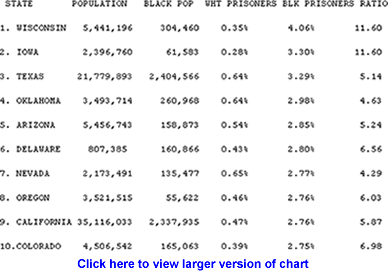
Texas, the nation’s second largest state, is the third worst place to be black in America, and is in a class by itself, first because its extraordinary rate of black incarceration affects such a large population. Only New York has more African Americans than Texas, and only the two relatively small states previously mentioned lock up a higher percentage of their black citizens. Though California has 50 percent more people, Texas has a slightly larger prison population and only a 5 to 1 ratio between its black and white rates of imprisonment. We may safely assume that since very few of its wealthy Texans are behind bars, Texas is just a very bad place to be poor, whether you’re black or not.
A total of 900,000 African Americans live in Oklahoma, Arizona, Delaware, Nevada, Oregon and Colorado, and another 2 million-plus in California, where the proportion of prisoners among total African Americans hovers just under 3 percent.
How Much Better is Better? How Much Worse is Worst?
The answer in both cases is, unfortunately: not much. Only one hundredth of a percentage point separates Iowa’s 3.30% rate of black incarceration from that of Texas, with 3.29%. Twenty-seven more states manage to lock up between 2 and 3% of their African American inhabitants, and only Maine, Hawaii and North Dakota fail to incarcerate more than 1.55% of blacks. For whites, the national average ratio of prisoners to the general population is less than 4 tenths of one percent.
The damning truth laid bare once again by this fact, is that America’s policy of racially selective policing, prosecuting and imprisonment of its black one-eighth is a truly consistent and national one, even though it is implemented with arbitrary severity by countless state and local authorities.
Dishonorable Mentions
This distinction goes to New Jersey, Connecticut, Minnesota, Pennsylvania, and New York.
"Minnesota had the fastest growing prison population in the country as of mid-year 2004."
BC’s Dishonorable Mention is reserved for those states not already enumerated which have the highest disparity between black and white incarceration rates. Wisconsin and Iowa belong here too, with disparity rates between 11 and 12 to one, but they have already been mentioned. This dismal category is especially significant because black populations in three of the states with extraordinary disparity rates fall largely within the New York City Metropolitan Statistical area, the largest concentration of black people in North America. Suffice it to say that for practical purposes, New York City and its environs are not that much better a place to be black than Texas.
STATE...........BLACK-WHITE DISPARITY
New Jersey............13.15 to one
Connecticut...........12.77 to one
Minnesota.............12.63 to one
Pennsylvania..........10.53 to one
New York.............. 9.47 to one
The second largest concentration of African Americans in New Jersey lies within the Philadelphia Metropolitan Statistical Area. Note Pennsylvania’s fourth place ranking on the Dishonorable list.
The “enlightened” state of Minnesota has two more peculiar distinctions. First, it commits one of the nation’s largest percentages of offenders to community corrections, the generic name for “non-prison” sentencing alternatives. With one of the nation’s highest rates of disparity between its black and white inhabitants, it appears that Minnesota’s white offenders are disproportionately funneled into alternative sentencing situations, but we have no data to support such a conclusion. Secondly, according to the Justice Department’s Bureau of Justice Statistics, which together with the US Census Department is the source for all numerical data in this article, Minnesota had the fastest growing prison population in the country as of mid-year 2004, the latest date for which stats are publicly available.
What About the South?
"The old South is just not a good place to be poor, whether one is black or white."
Alert readers may have noticed that except for Delaware and Texas, not a single southern state made BC’s Ten Worst or its Dishonorable Mention, even though Louisiana is well known to have the nation’ highest per capita rate of incarceration for its whole population. How is this possible?
The answer is that our ranking is based solely on the percentage of a state’s black population behind state and local prison walls. The following table sorts the top 13 states in order of their relative black populations, from Mississippi with 36% to Illinois with 15%. This statistical approach catches all the states of the old South except Texas and Florida, and reveals an interesting pattern.
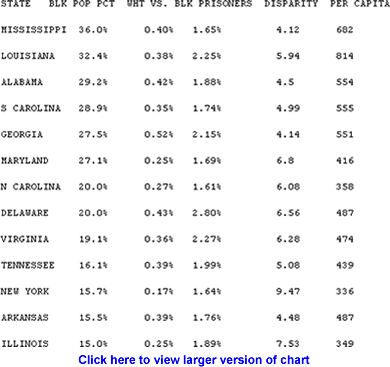
All eleven southern states in this table lock up noticeably higher per capita numbers of their whole populations, black, white and otherwise, than do New York and Illinois. But southern rates of disparity between black and white imprisonment do not approach those of Illinois at 7.5 to one or New York’s 9.5 to one. Like Texas, nine of these eleven Southern states achieve their overall high imprisonment rates by confining white people to prison twice as often as New York and Illinois. Furthermore, the five states with the highest black percentage of their total populations have rates of black imprisonment closer to those of Illinois and New York than to Texas. Like Texas, the Old South is just not a good place to be poor, whether one is black or white.
Federal Prisoners: Another Texas and then some
Finally, discerning readers have probably noticed that near the beginning of this article the proportion of all African Americans in the nation’s prisons and jails was given as about 3%, but the numbers quoted for only three states reached or exceeded that figure. How did we get three percent?
"Problems created by bad public policies demand solutions that include changing those destructive policies."
The missing incarcerated, who did not figure in BC’s calculations for the Dishonorable Mentions and Ten Worst list because BC was unable to sort out their states of origin, race or region, are those in federal prisons and jails. The federal gulag held about 170,000 people as of mid-year 2004, according to the Bureau of Justice Statistics, slightly more than the Texas prison system, and growing much faster. We have not yet obtained racial breakdown data for federal prisons, but if and when it becomes available it may show racial disparities as severe as those in Illinois, which would suffice to make almost half of federal inmates African American.
Better Lives, Better Families, Better Communities
The work of reclaiming lives, families and communities shredded by America’s incarceration binge must take place in hundreds of cities and towns and in several arenas. Thousands of churches and local organizations are trying with scant resources to provide re-entry services to former prisoners. While their efforts deserve praise and support, BC believes that problems created by bad public policies demand solutions that include changing those destructive policies. In fact, it is misleading and foolish to portray the problem of racially selective mass imprisonment as one addressable by a million individual solutions, by several hundred thousand family solutions, or by ten thousand black church and small business solutions.
The problem is that public policy in America only moves in the direction of addressing human needs when under the insistent pressure of mass movements. Where will the mass movement come from to change America’s racially selective policy of mass incarceration? What will be its first tasks, and what will it look like? These are among the key questions before black activists for the immediate future.
Bruce Dixon is the Managing Editor at Black Agenda Report. He can be reached at bruce.dixon(at)blackagendareport.com

 In this week’s segment we hear about the right-wing politics of the anti-migrant movement in South Africa, ANC failures, and upcoming elections in that country. But we begin with the first and only…
 Chris Smalls discusses his memoir, "When the Revolution Comes: A Fight for the Future of the Working Class," published by Penguin Random House. He is the first and only union leader to successfully…
 Our guest is Nairobi based political writer and strategist Clinton Nzala. He joins us to provide an update and an analysis of the South African anti-migrant March and March movement, which is…
 The Hague Group’s goal is to “. . . take coordinated legal and diplomatic measures against Israel’s violations of international law.” But international law was never a reality.
 “I believe that the Movement of Nonaligned Countries…can buttress the united will of the Arab nation and help it to prevail against intervention and aggression.”


