by Nathalie Woods
Frequent BAR contribuor Dr. Sikivu Hutchinson’s new book confronts the web of patrimony and religiosity that often binds Black America to its historical tormentors. “Despite longstanding traditions of secular humanism, skepticism, and Freethought espoused by such thinkers as Frederick Douglass, Zora Neale Hurston, Nella Larsen and Richard Wright, Atheism remains a taboo belief system in black communities.”
Moral Combat: An Interview with Dr. Sikivu Hutchinson
by Nathalie Woods
This interview originally appeared in Echoes Of Common Sense.
With the fresh release of her thought-inspiring title, erudite author of Moral Combat: Black Atheist, Gender Politics and the Value Wars, Dr. Sikivu Hutchinson, among other things, discusses her inspirations for writing this relevant title, and how topical issues in the book can help our modern society. Sit back and enjoy the hot dialogue conducted by Echoes of Commonsense editor Nathalie Woods.
“Ideologically, black atheists are distinct from white atheists in that they emphasize social justice and human rights rather than just fixating on science and the separation of church and state.”
Q: The title of your latest book is very succinct, and especially relevant to our Modern Age; why this book, and why now?
A: Because religion is still America’s national obsession, perversion, and most insidious global export and atheists are on the move. In the book I examine the implications of black Christian religiosity, skepticism, humanism, and atheism from an African American feminist perspective, taking on Christian fundamentalist fascism and the hijacking of public morality. The so-called “New Atheist” movement has galvanized a broad cross-section of atheists who’ve been increasingly vocal about this. However, despite longstanding traditions of secular humanism, skepticism, and Freethought espoused by such thinkers as Frederick Douglass, Zora Neale Hurston, Nella Larsen and Richard Wright, Atheism remains a taboo belief system in black communities. According to the Pew Forum’s 2009 “Religious Portrait of African-Americans” 87% of African Americans describe themselves as religious.”[i] A majority of African American women go to church on a weekly basis and a majority of African Americans pray and believe that God absolutely exists. Hands down African Americans are the most religious group in the U.S.
Q: From your scholarly experience in Cultural Studies, what do you think are the factors responsible for African-Americans’ obsessive adherents to religious practices?
A: It’s important to place black religiosity in both historical and socioeconomic context. Historically, organized religion allowed African Americans to achieve a sense of community, identity, subjectivity, and human worth under the holocaust conditions of American slavocracy. Those traditions have functioned as a form of insulation from both Jim Crow and de facto segregation. Over the past several decades, conservative reactionary public policies have all but decimated social welfare in poor and working class communities. In transit dependent, low income communities of color with limited job, education, health care, and recreational opportunities churches become a life line for some. For example, due to the intractability of residential segregation in black communities the Black Church has provided social welfare resources from computer training, utility assistance, and prisoner re-entry programs to recreation. Further, the intersection of institutional racism and global capitalism has stymied sustainable retail and commercial development. In addition, Christianity has always functioned as a validation of white supremacy and white “civilization.”
“Becoming Christian was a means of becoming moral, becoming human, and, in a twisted way, becoming de facto Americans.”
This is why white Middle America has had such fascistic conniptions over Obama’s covert “Muslim” identity. Initially, colonial law held that Christians could not be enslaved. This belief and practice shifted with the institutionalization of racial slavery in the late 17th century. So in many regards blacks’ adoption of Christianity was also compensatory; becoming Christian was a means of becoming moral, becoming human, and, in a twisted way, becoming de facto Americans. Given these dynamics, for many black atheists, actively breaking with religious tradition means you’re surely going to hell! According to writer Donald Barbera, “Probably the most controversial stance in the majority black community is the disbelief or disregard for a personal God…non-believers and freethinkers in the black community tend not to shout it out. They are invisible in a sea of Christianity.”[ii] This invisibility is partly due to the fact that the history of African American civil and human rights resistance is heavily steeped in Judeo-Christian religious dogma, which powered the rise of the Black Church. Despite white Christian justification for slavery and domestic terrorism, African Americans converted to Christianity and utilized it as a source of succor, community and spiritual redemption.
Q: There have been many contemporary critiques about the historical role of the Black Church in black civil rights struggle and black life. What about the socioeconomic implications of black church affiliation?
A: It’s important to understand that black religiosity emerges from a culturally specific survival strategy. It is in many ways a form of dialogue with the unique paradoxes of American national identity. Urban black churches are a reminder that racial segregation is still very much the defining factor of contemporary American life. They remind us that the bromides of post-racialism and colorblindness are toxically false. They sit in silent witness to the race/class metamorphosis of “inner city” neighborhoods, memorializing the ritual turn from white to black and brown. They flatter the rich and damn the poor to dependence, testifying to the lie of American exceptionalism and the American dream. They provide a window onto how faith-based social welfare buttresses capitalism. In below poverty level communities with a church on every corner, commerce and “the sacred” are wedded as the antidote to ghetto “depravity.” So in communities of color, the business of saving souls continues apace. The moral authority of religious culture (if not churches themselves) remains largely unchallenged, and the absence of flesh and blood black secular humanist institutions underscores faith’s racial divide.
Q: What major commonalities do the African-American Freethinkers, Humanists, and Atheists share?
A: In my research on African American atheists, freethinkers, and humanists across the country, several recurring themes emerge. Many have felt the sting of marginalization and otherness, if not outright ostracism. Many have found voice through atheist online networks. Some remain “closeted” due to convention and fear of social stigma. A small minority have “come out” as atheists in their real time networks and communities. Black secularists on the East Coast are far more visible than those in any other region of the country. Ideologically, black atheists are distinct from white atheists in that they emphasize social justice and human rights rather than just fixating on science and the separation of church and state. Black women who identify as atheist and humanist exhibit strong feminist and anti-heterosexist world views on gender roles, the family, sexuality, cultural identity, and education. Black men who identify as atheist and humanist generally support gender equity principles and hold liberal political views. Virtually all hunger for greater political visibility and sustained real time community. Over the past two decades the Black Church has increasingly come under fire from black progressives for its homophobia, its failure to act on the African American HIV/AIDS epidemic, its sexist treatment of women, and its financial improprieties. Many progressive worshippers have criticized these disparities and sought to change the church from within. However they are distinguished from those who have made a definitive break with religious faith for secular moral and ethical reasons.
Q: What’s your view on same sex marriage; don’t you regard it as another immoral decadence that needs combating in a community of Freethinkers who are supposedly rational people?
A: Opposition to same-sex marriage is emblematic of the same fascistic heterosexist patriarchal regime that constructs women as territory and condemns the human rights of gays and lesbians as an abomination.
Q: What is the story behind your disbelief in Orthodox theology?
A: I grew up in a secular household. Both of my parents were activist, socially conscious agnostic/humanist in orientation, black-identified, non-conformist. Needless to say our lack of religious belief or regular churchgoing was an anomaly in the predominantly black community that we lived in. The majority of my friends went to church and professed a belief in God, however, with the possible exception of the zealot preacher’s kid who tried to convert me, I never felt overtly pressured to be religious by my peers. On the other hand I didn’t know any other kids whose parents were explicitly secular, and I certainly didn’t encounter any self-proclaimed atheists in the community. Door-to-door bible thumpers, Jehovah’s Witness,’ etc. were a regular presence and churches were an intimate part of the fabric of the neighborhood.
Q: You approach your critique from a feminist perspective. What are the specific pitfalls of religiosity and coming out as an atheist for black women?
A: The challenges of achieving baseline skepticism in a traditionally religious, racially and economically disenfranchised community are especially onerous for women. Constructions of mainstream African American female gender roles and social responsibilities are unquestionably linked to religiosity. While black women fill the church pews, few of them are deacons, pastors, and Bishops in the patriarchal Black Church. Of course, as “keepers of home and hearth,” black women are vital to upholding patriarchal roles and responsibilities. If the Black Church, as an embattled institution, has had a “redeemer” it has been the perseverance of black women. Thus, for many black women, skepticism, humanism, and atheism are dangerous frontiers that fundamentally threaten their sense of gendered identity and social mooring.
“Black women who openly profess non-theist views are deemed especially traitorous, having ‘abandoned’ their primary role as purveyors of cultural and religious tradition.”
Consequently, when it comes to attitudes about traditional gender roles, gender-based assumptions about black female religiosity are double-edged. While black male non-believers are given more leeway to be heretics or just MIA from church, black women who openly profess non-theist views are deemed especially traitorous, having “abandoned” their primary role as purveyors of cultural and religious tradition. 19th century Cult of True Womanhood paradigms of idealized pure white domesticated moral femininity still bedevil black women. Shopworn images of black women faithfully shuttling their children to church and socializing them into Christianity are a prominent part of mainstream black culture. Tired caricatures of bible thumping God fearing Madea-esque black women abound in American pop culture. And if being black and being Christian are synonymous, then being black, female, and religious or “spiritual” (whatever the denomination or belief system) is practically compulsory. Insofar as atheism is an implicit rejection of both black patriarchy and “authentic” blackness, black women who would dare to publicly identify as atheists are potential race traitors and gender apostates.
Q: What is the relevance of your book to the advancement of morality in the world, and where can readers find it?
A: The book assesses the social construction of public morality in America vis-à-vis race, gender, sexual orientation and class. For the past several decades, much of mainstream public morality has been framed by the Religious Right’s millennialist values wars against social justice and human rights. In this universe, being moral is all about taking rights away from others in service to a narrow nationalist racist sexist notion of what it means to be authentically American. Chris Hedges and others have identified this upheaval as Christian fascism. In the book, I look at the unique cultural foundations of American public morality with respect to white supremacist notions of self and other. If morality can be defined as defense against the amoral other then power and social control are easy to maintain. The entire narrative of American progress and meritocracy is based on the inherent morality and inevitability of racial hierarchy. Rich white people who control the majority of the wealth in the U.S. (and, yes, race is important here because the top 1% of the super rich are predominantly European American) have achieved this status through pluck, discipline, and persistence, i.e., moral grit. So, if poor black people are implicitly lazy, shiftless, and lacking a work ethic, then not only are they lacking in morals but white folks who “bootstrapped” their way up through their own true grit and individual enterprise are by definition morally superior. If women don’t allow their bodies and destinies to be violently controlled by the state, patriarchy, and organized religion (which are often interchangeable) then it stands to reason that they are immoral. If gays and lesbians don’t allow themselves to be socially exterminated then of course they are immoral. If third world peoples insist upon anti-imperialist self-determination free from the geopolitical rookery of the West then they must be against democracy, rationality, and human rights.
“The book challenges the reader to move beyond religious dogma to fundamentally humanist questions of what it means to be a democratic society.”
The book defines morality in terms of social justice and the inalienable human right to social justice. For example, I spend a considerable amount of time looking at how urban space has historically been deemed immoral and degraded. The 18th century Jeffersonian rural ideal lives on in the homogeneity of the suburban ideal. Racially segregated suburbs were originally conceived as an escape from the messiness and “pathology” of urban diversity. Because of institutional racism and the systematic undermining of affordable public housing and equitable mortgage financing urban areas have always been marked as racially other. The gentrification of historically black and Latino urban communities has made the picture more complex, but the ethos is still the same—black and Latino communities are considered to be pathological ghettoes/war zones where no self-respecting white person without a development deal or a brand spanking new renovated condo would dare to tread. Thus, the book challenges and broadens mainstream notions of morality. It challenges the reader to move beyond religious dogma to fundamentally humanist questions of what it means to be a democratic society that assigns moral worth to the right to housing, a living wage job and an equitable education. What does it mean to give moral worth to gay and lesbian humanity and subjectivity? What does it mean to view reproductive justice and abortion as a moral right? What does it mean to have an educational system that assigns moral worth to the cultural and social capital of people of color, granting visibility to the lived experiences, social history, and cultural knowledge of people of color in school curricula? What does it mean to view the mass incarceration of black people in this country as an immoral miscarriage of justice and democracy, and as a betrayal of supposedly American principles? These are the moral contradictions and issues that I surface in the book which I hope will be used as the basis for a progressive, activist vision of humanism.
The book is available at CreateSpace and Amazon.com. Sikivu Hutchinson is the editor of blackfemlens.org and a senior fellow for the Washington D.C.-based Institute for Humanist Studies.
REF: [i] “A Religious Portrait of African Americans,” The Pew Forum on Religion and Public Life, January 30, 2009, 1.
[ii] Donald Barbera, Black and Not-Baptist: Nonbelief and Freethought in the African American Community, (Illinois: iUniverse, 2003) 22.

 In this week’s segment, we discuss the US effort to control the world’s oil and gas supplies in Venezuela, Iran, and other nations, and to disrupt and steal supplies going to and from Russia and Ch
 Ajamu Baraka is a Black Agenda Report contributing editor and Director of the North-South Project for People(s)-Centered Human Rights. The North-South Project is among the organizations calling for…
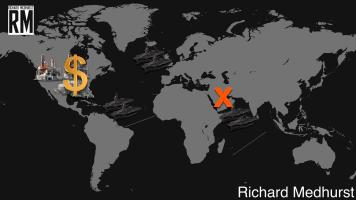 Richard Medhurst discusses his latest investigative reporting, “The Petrogas-Dollar: The Secret US Strategy Behind the Iran War," an analysis of the latest iteration of U.S. hegemony. The U.S. is…
 The U.S. regime change plot against Venezuela succeeded and created a puppet state. Anti-imperialists must admit this reality and forge plans for fighting against it.
 Oh, carrier Intrepid/you in these torrid waters of Santo Domingo/only out of fear.


